Showing posts with label amongst. Show all posts

Tuesday, October 6, 2015

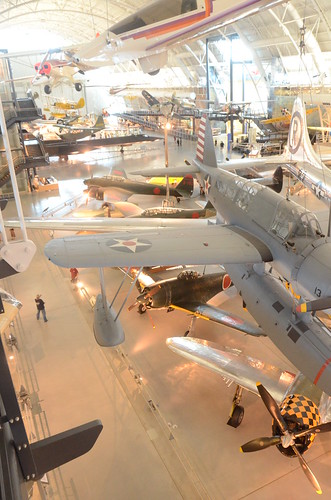
Steven F. Udvar-Hazy Center: P-40 Warhawk & F-4 Corsair hanging more than the SR-71 Blackbird, amongst other folks

Some cool machined components companies photos:


Steven F. Udvar-Hazy Center: P-40 Warhawk & F-4 Corsair hanging over the SR-71 Blackbird, amongst other folks

Image by Chris Devers

Quoting Smithsonian National Air and Space Museum | Curtiss P-40E Warhawk (Kittyhawk IA):


Whether or not identified as the Warhawk, Tomahawk, or Kittyhawk, the Curtiss P-40 proved to be a profitable, versatile fighter in the course of the very first half of World War II. The shark-mouthed Tomahawks that Gen. Claire Chennault’s &quotFlying Tigers&quot flew in China against the Japanese stay among the most popular airplanes of the war. P-40E pilot Lt. Boyd D. Wagner became the very first American ace of Globe War II when he shot down six Japanese aircraft in the Philippines in mid-December 1941.


Curtiss-Wright constructed this airplane as Model 87-A3 and delivered it to Canada as a Kittyhawk I in 1941. It served till 1946 in No. 111 Squadron, Royal Canadian Air Force. U.S. Air Force personnel at Andrews Air Force Base restored it in 1975 to represent an aircraft of the 75th Fighter Squadron, 23rd Fighter Group, 14th Air Force.


Donated by the Exchange Club in Memory of Kellis Forbes.


Manufacturer:
Curtiss Aircraft Firm


Date:

1939


Nation of Origin:

United States of America


Dimensions:

All round: 330 x 970cm, 2686kg, 1140cm (10ft 9 15/16in. x 31ft 9 7/8in., 5921.6lb., 37ft four 13/16in.)


Supplies:

All-metal, semi-monocoque


Physical Description:

Single engine, single seat, fighter aircraft.


• • • • •


See much more images of this, and the Wikipedia article.


Details, quoting from Smithsonian National Air and Space Museum | Lockheed SR-71 Blackbird:


No reconnaissance aircraft in history has operated globally in more hostile airspace or with such total impunity than the SR-71, the world’s quickest jet-propelled aircraft. The Blackbird’s functionality and operational achievements placed it at the pinnacle of aviation technology developments for the duration of the Cold War.


This Blackbird accrued about two,800 hours of flight time throughout 24 years of active service with the U.S. Air Force. On its last flight, March 6, 1990, Lt. Col. Ed Yielding and Lt. Col. Joseph Vida set a speed record by flying from Los Angeles to Washington, D.C., in 1 hour, 4 minutes, and 20 seconds, averaging 3,418 kilometers (2,124 miles) per hour. At the flight’s conclusion, they landed at Washington-Dulles International Airport and turned the airplane over to the Smithsonian.


Transferred from the United States Air Force.


Manufacturer:
Lockheed Aircraft Corporation


Designer:
Clarence L. &quotKelly&quot Johnson


Date:

1964


Country of Origin:

United States of America


Dimensions:

All round: 18ft five 15/16in. x 55ft 7in. x 107ft 5in., 169998.5lb. (5.638m x 16.942m x 32.741m, 77110.8kg)

Other: 18ft 5 15/16in. x 107ft 5in. x 55ft 7in. (5.638m x 32.741m x 16.942m)


Components:

Titanium


Physical Description:

Twin-engine, two-seat, supersonic strategic reconnaissance aircraft airframe constructed largley of titanium and its alloys vertical tail fins are constructed of a composite (laminated plastic-kind material) to reduce radar cross-section Pratt and Whitney J58 (JT11D-20B) turbojet engines feature massive inlet shock cones.


• • • • •


Quoting Smithsonian National Air and Space Museum | Vought F4U-1D Corsair :


By V-J Day, September 2, 1945, Corsair pilots had amassed an 11:1 kill ratio against enemy aircraft. The aircraft’s distinctive inverted gull-wing style permitted ground clearance for the enormous, three-bladed Hamilton Common Hydromatic propeller, which spanned a lot more than four meters (13 feet). The Pratt and Whitney R-2800 radial engine and Hydromatic propeller was the largest and one particular of the most strong engine-propeller combinations ever flown on a fighter aircraft.


Charles Lindbergh flew bombing missions in a Corsair with Marine Air Group 31 against Japanese strongholds in the Pacific in 1944. This airplane is painted in the colors and markings of the Corsair Sun Setter, a Marine close-help fighter assigned to the USS Essex in July 1944.


Transferred from the United States Navy.


Manufacturer:
Vought Aircraft Business


Date:

1940


Country of Origin:

United States of America


Dimensions:

All round: 460 x 1020cm, 4037kg, 1250cm (15ft 1 1/8in. x 33ft 5 9/16in., 8900lb., 41ft 1/8in.)


Supplies:

All metal with fabric-covered wings behind the primary spar.


Physical Description:

R-2800 radial air-cooled engine with 1,850 horsepower, turned a three-blade Hamilton Standard Hydromatic propeller with solid aluminum blades spanning 13 feet 1 inch wing bent gull-shaped on each sides of the fuselage.

Saturday, August 22, 2015

Steven F. Udvar-Hazy Center: South hangar panorama, like Vought OS2U-3 Kingfisher seaplane, B-29 Enola Gay, amongst others

Some cool precision element makers photos:


Steven F. Udvar-Hazy Center: South hangar panorama, which includes Vought OS2U-3 Kingfisher seaplane, B-29 Enola Gay, amongst other people


Image by Chris Devers

Quoting Smithsonian National Air and Space Museum | Vought OS2U-3 Kingfisher:


The Kingfisher was the U.S. Navy’s main ship-primarily based, scout and observation aircraft in the course of Planet War II. Revolutionary spot welding strategies gave it a smooth, non-buckling fuselage structure. Deflector plate flaps that hung from the wing’s trailing edge and spoiler-augmented ailerons functioned like further flaps to permit slower landing speeds. Most OS2Us operated in the Pacific, where they rescued numerous downed airmen, like Planet War I ace Eddie Rickenbacker and the crew of his B-17 Flying Fortress.


In March 1942, this airplane was assigned to the battleship USS Indiana. It later underwent a six-month overhaul in California, returned to Pearl Harbor, and rejoined the Indiana in March 1944. Lt. j.g. Rollin M. Batten Jr. was awarded the Navy Cross for making a daring rescue in this airplane below heavy enemy fire on July four, 1944.


Transferred from the United States Navy.


Manufacturer:
Vought-Sikorsky Aircraft Division


Date:

1937


Nation of Origin:

United States of America


Dimensions:

All round: 15ft 1 1/8in. x 33ft 9 1/2in., 4122.6lb., 36ft 1 1/16in. (460 x 1030cm, 1870kg, 1100cm)


Materials:

Wings covered with fabric aft of the main spar


Physical Description:

Two-seat monoplane, deflector plate flaps hung from the trailing edge of the wing, ailerons drooped at low airspeeds to function like extra flaps, spoilers.


• • • • •


Quoting Smithsonian National Air and Space Museum | Boeing B-29 Superfortress &quotEnola Gay&quot:


Boeing’s B-29 Superfortress was the most sophisticated propeller-driven bomber of World War II and the initial bomber to residence its crew in pressurized compartments. Although designed to fight in the European theater, the B-29 identified its niche on the other side of the globe. In the Pacific, B-29s delivered a range of aerial weapons: traditional bombs, incendiary bombs, mines, and two nuclear weapons.


On August six, 1945, this Martin-constructed B-29-45-MO dropped the initial atomic weapon used in combat on Hiroshima, Japan. Three days later, Bockscar (on show at the U.S. Air Force Museum close to Dayton, Ohio) dropped a second atomic bomb on Nagasaki, Japan. Enola Gay flew as the advance climate reconnaissance aircraft that day. A third B-29, The Wonderful Artiste, flew as an observation aircraft on each missions.


Transferred from the United States Air Force.


Manufacturer:
Boeing Aircraft Co.
Martin Co., Omaha, Nebr.


Date:

1945


Nation of Origin:

United States of America


Dimensions:

All round: 900 x 3020cm, 32580kg, 4300cm (29ft six five/16in. x 99ft 1in., 71825.9lb., 141ft 15/16in.)


Components:

Polished overall aluminum finish


Physical Description:

Four-engine heavy bomber with semi-monoqoque fuselage and higher-aspect ratio wings. Polished aluminum finish general, common late-World War II Army Air Forces insignia on wings and aft fuselage and serial quantity on vertical fin 509th Composite Group markings painted in black &quotEnola Gay&quot in black, block letters on reduce left nose.


Steven F. Udvar-Hazy Center: South hangar panorama, including Vought OS2U-three Kingfisher seaplane, B-29 Enola Gay, among other folks


Image by Chris Devers

Quoting Smithsonian National Air and Space Museum | Vought OS2U-3 Kingfisher:


The Kingfisher was the U.S. Navy’s primary ship-based, scout and observation aircraft during Globe War II. Revolutionary spot welding strategies gave it a smooth, non-buckling fuselage structure. Deflector plate flaps that hung from the wing’s trailing edge and spoiler-augmented ailerons functioned like extra flaps to allow slower landing speeds. Most OS2Us operated in the Pacific, where they rescued many downed airmen, like Globe War I ace Eddie Rickenbacker and the crew of his B-17 Flying Fortress.


In March 1942, this airplane was assigned to the battleship USS Indiana. It later underwent a six-month overhaul in California, returned to Pearl Harbor, and rejoined the Indiana in March 1944. Lt. j.g. Rollin M. Batten Jr. was awarded the Navy Cross for generating a daring rescue in this airplane under heavy enemy fire on July four, 1944.


Transferred from the United States Navy.


Manufacturer:
Vought-Sikorsky Aircraft Division


Date:

1937


Nation of Origin:

United States of America


Dimensions:

All round: 15ft 1 1/8in. x 33ft 9 1/2in., 4122.6lb., 36ft 1 1/16in. (460 x 1030cm, 1870kg, 1100cm)


Supplies:

Wings covered with fabric aft of the major spar


Physical Description:

Two-seat monoplane, deflector plate flaps hung from the trailing edge of the wing, ailerons drooped at low airspeeds to function like extra flaps, spoilers.