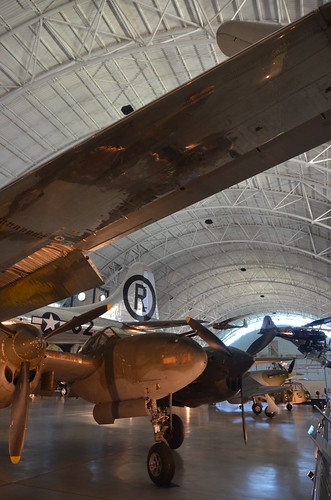
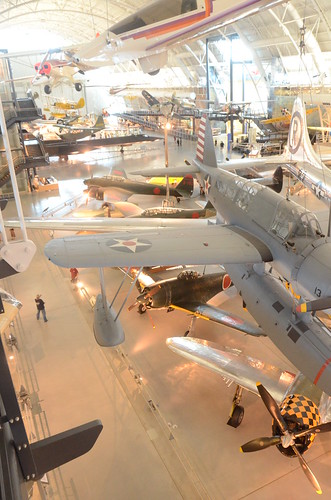
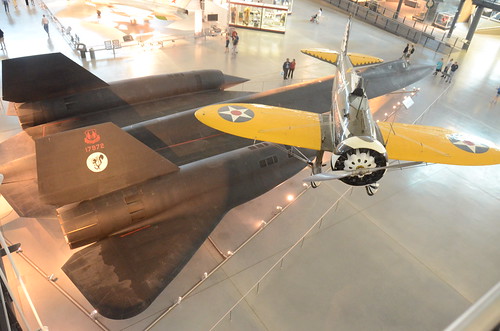
Showing posts with label Center. Show all posts

Wednesday, October 14, 2015

Steven F. Udvar-Hazy Center: Vought F4U-1D Corsair

Verify out these surface grinding manufacturer images:


Steven F. Udvar-Hazy Center: Vought F4U-1D Corsair
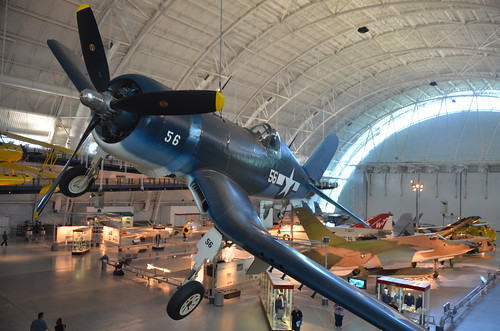
Image by Chris Devers
See more images of this, and the Wikipedia article.


Details, quoting from Smithsonian National Air and Space Museum | Vought F4U-1D Corsair:


By V-J Day, September 2, 1945, Corsair pilots had amassed an 11:1 kill ratio against enemy aircraft. The aircraft’s distinctive inverted gull-wing design permitted ground clearance for the huge, 3-bladed Hamilton Regular Hydromatic propeller, which spanned more than 4 meters (13 feet). The Pratt and Whitney R-2800 radial engine and Hydromatic propeller was the biggest and one of the most effective engine-propeller combinations ever flown on a fighter aircraft.


Charles Lindbergh flew bombing missions in a Corsair with Marine Air Group 31 against Japanese strongholds in the Pacific in 1944. This airplane is painted in the colors and markings of the Corsair Sun Setter, a Marine close-help fighter assigned to the USS Essex in July 1944.


Transferred from the United States Navy.


Manufacturer:
Vought Aircraft Firm


Date:

1940


Nation of Origin:

United States of America


Dimensions:

All round: 460 x 1020cm, 4037kg, 1250cm (15ft 1 1/8in. x 33ft 5 9/16in., 8900lb., 41ft 1/8in.)


Components:

All metal with fabric-covered wings behind the major spar.


Physical Description:

R-2800 radial air-cooled engine with 1,850 horsepower, turned a 3-blade Hamilton Normal Hydromatic propeller with solid aluminum blades spanning 13 feet 1 inch wing bent gull-shaped on each sides of the fuselage.


Extended Description:

On February 1, 1938, the United States Navy Bureau of Aeronautics requested proposals from American aircraft companies for a new carrier-based fighter airplane. During April, the Vought Aircraft Corporation responded with two styles and 1 of them, powered by a Pratt &amp Whitney R-2800 engine, won the competitors in June. Much less than a year later, Vought test pilot Lyman A. Bullard, Jr., first flew the Vought XF4U-1 prototype on Might 29, 1940. At that time, the largest engine driving the biggest propeller ever flown on a fighter aircraft propelled Bullard on this test flight. The R-2800 radial air-cooled engine developed 1,850 horsepower and it turned a three-blade Hamilton Normal Hydromatic propeller with solid aluminum blades spanning 13 feet 1 inch.


The airplane Bullard flew also had yet another striking function, a wing bent gull-shaped on each sides of the fuselage. This arrangement gave additional ground clearance for the propeller and reduced drag at the wing-to-fuselage joint. Ironically for a 644-kph (400 mph) airplane, Vought covered the wing with fabric behind the principal spar, a practice the firm also followed on the OS2U Kingfisher (see NASM collection).


When naval air strategists had crafted the specifications for the new fighter, the require for speed had overridden all other functionality targets. With this in thoughts, the Bureau of Aeronautics selected the most powerful air-cooled engine available, the R-2800. Vought assembled a team, lead by chief designer Rex Biesel, to design the ideal airframe about this strong engine. The group incorporated project engineer Frank Albright, aerodynamics engineer Paul Baker, and propulsion engineer James Shoemaker. Biesel and his team succeeded in developing a very quickly fighter but when they redesigned the prototype for production, they have been forced to make an unfortunate compromise.


The Navy requested heavier armament for production Corsairs and Biesel redesigned each and every outboard folding wing panel to carry three .50 caliber machine guns. These guns displaced fuel tanks installed in every single wing top edge. To replace this lost capacity, an 897-liter (237 gal) fuselage tank was installed in between the cockpit and the engine. To maintain the speedy and narrow fuselage profile, Biesel could not stack the cockpit on leading of the tank, so he moved it almost three feet aft. Now the wing totally blocked the pilot’s line of sight for the duration of the most vital stages of landing. The early Corsair also had a vicious stall, effective torque and propeller effects at slow speed, a brief tail wheel strut, major gear struts that often bounced the airplane at touchdown, and cowl flap actuators that leaked oil onto the windshield. These issues, combined with the lack of cockpit visibility, made the airplane almost not possible to land on the tiny deck of an aircraft carrier. Navy pilots quickly nicknamed the F4U the ‘ensign eliminator’ for its tendency to kill these inexperienced aviators. The Navy refused to clear the F4U for carrier operations until late in 1944, a lot more than seven years right after the project started.


This flaw did not deter the Navy from accepting Corsairs since Navy and Marine pilots sorely necessary an enhanced fighter to replace the Grumman F4F Wildcat (see NASM collection). By New Year’s Eve, 1942, the service owned 178 F4U-1 airplanes. Early in 1943, the Navy decided to divert all Corsairs to land-based United States Marine Corps squadrons and fill Navy carrier-based units with the Grumman F6F Hellcat (see NASM collection). At its ideal speed of 612 kph (380 mph) at six,992 m (23,000 ft), the Hellcat was about 24 kph (15 mph) slower than the Corsair but it was a joy to fly aboard the carrier. The F6F filled in splendidly until improvements to the F4U certified it for carrier operations. Meanwhile, the Marines on Guadalcanal took their Corsairs into combat and engaged the enemy for the first time on February 14, 1943, six months prior to Hellcat pilots on that battle-scared island initial encountered enemy aircraft.


The F4U had an quick influence on the Pacific air war. Pilots could use the Corsair’s speed and firepower to engage the more maneuverable Japanese airplanes only when the benefit favored the Americans. Unprotected by armor or self-sealing fuel tanks, no Japanese fighter or bomber could withstand for far more than a few seconds the concentrated volley from the six .50 caliber machine guns carried by a Corsair. Major Gregory &quotPappy&quot Boyington assumed command of Marine Corsair squadron VMF-214, nicknamed the ‘Black Sheep’ squadron, on September 7, 1943. During much less than five months of action, Boyington received credit for downing 28 enemy aircraft. Enemy aircraft shot him down on January three, 1944, but he survived the war in a Japanese prison camp.


In Might and June 1944, Charles A. Lindbergh flew Corsair missions with Marine pilots at Green Island and Emirau. On September three, 1944, Lindbergh demonstrated the F4U’s bomb hauling capacity by flying a Corsair from Marine Air Group 31 carrying three bombs every single weighing 450 kg (1,000 lb). He dropped this load on enemy positions at Wotje Atoll. On the September 8, Lindbergh dropped the first 900-kg (two,000 lb) bomb during an attack on the atoll. For the finale 5 days later, the Atlantic flyer delivered a 900-kg (2,000 lb) bomb and two 450-kg (1,000 lb) bombs. Lindbergh went ahead and flew these missions following the commander of MAG-31 informed him that if he was forced down and captured, the Japanese would nearly certainly execute him.


As of V-J Day, September 2, 1945, the Navy credited Corsair pilots with destroying two,140 enemy aircraft in aerial combat. The Navy and Marines lost 189 F4Us in combat and 1,435 Corsairs in non-combat accidents. Starting on February 13, 1942, Marine and Navy pilots flew 64,051 operational sorties, 54,470 from runways and 9,581 from carrier decks. During the war, the British Royal Navy accepted 2,012 Corsairs and the Royal New Zealand Air Force accepted 364. The demand was so fantastic that the Goodyear Aircraft Corporation and the Brewster Aeronautical Corporation also produced the F4U.


Corsairs returned to Navy carrier decks and Marine airfields for the duration of the Korean War. On September 10, 1952, Captain Jesse Folmar of Marine Fighter Squadron VMF-312 destroyed a MiG-15 in aerial combat more than the west coast of Korea. However, F4U pilots did not have several air-to-air encounters over Korea. Their major mission was to assistance Allied ground units along the battlefront.


Following the World War II, civilian pilots adapted the speedy bent-wing bird from Vought to fly in competitive air races. They preferred modified versions of the F2G-1 and -2 originally built by Goodyear. Corsairs won the prestigious Thompson Trophy twice. In 1952, Vought manufactured 94 F4U-7s for the French Navy, and these aircraft saw action more than Indochina but this order marked the end of Corsair production. In production longer than any other U.S. fighter to see service in Globe War II, Vought, Goodyear, and Brewster built a total of 12,582 F4Us.


The United States Navy donated an F4U-1D to the National Air and Space Museum in September 1960. Vought delivered this Corsair, Bureau of Aeronautics serial quantity 50375, to the Navy on April 26, 1944. By October, pilots of VF-ten had been flying it but in November, the airplane was transferred to VF-89 at Naval Air Station Atlantic City. It remained there as the squadron moved to NAS Oceana and NAS Norfolk. During February 1945, the Navy withdrew the airplane from active service and transferred it to a pool of surplus aircraft stored at Quantico, Virginia. In 1980, NASM craftsmen restored the F4U-1D in the colors and markings of a Corsair named &quotSun Setter,&quot a fighter assigned to Marine Fighter Squadron VMF-114 when that unit served aboard the &quotUSS Essex&quot in July 1944.


• • •


Quoting from Wikipedia | Vought F4U Corsair:


The Likelihood Vought F4U Corsair was a carrier-capable fighter aircraft that saw service mainly in Globe War II and the Korean War. Demand for the aircraft soon overwhelmed Vought’s manufacturing capability, resulting in production by Goodyear and Brewster: Goodyear-built Corsairs were designated FG and Brewster-constructed aircraft F3A. From the initial prototype delivery to the U.S. Navy in 1940, to final delivery in 1953 to the French, 12,571 F4U Corsairs had been manufactured by Vought, in 16 separate models, in the longest production run of any piston-engined fighter in U.S. history (1942–1953).


The Corsair served in the U.S. Navy, U.S. Marines, Fleet Air Arm and the Royal New Zealand Air Force, as nicely as the French Navy Aeronavale and other, smaller sized, air forces until the 1960s. It rapidly became the most capable carrier-based fighter-bomber of World War II. Some Japanese pilots regarded it as the most formidable American fighter of World War II, and the U.S. Navy counted an 11:1 kill ratio with the F4U Corsair.


F4U-1D (Corsair Mk IV): Constructed in parallel with the F4U-1C, but was introduced in April 1944. It had the new -8W water-injection engine. This adjust gave the aircraft up to 250&nbsphp (190&nbspkW) far more power, which, in turn, improved performance. Speed, for example, was boosted from 417 miles per hour (671&nbspkm/h) to 425 miles per hour (684&nbspkm/h). Since of the U.S. Navy’s require for fighter-bombers, it had a payload of rockets double the -1A’s, as nicely as twin-rack plumbing for an extra belly drop tank. Such modifications necessitated the require for rocket tabs (attached to totally metal-plated underwing surfaces) and bomb pylons to be bolted on the fighter, nonetheless, causing additional drag. Moreover, the role of fighter-bombing was a new task for the Corsair and the wing fuel cells proved also vulnerable and had been removed.[] The additional fuel carried by the two drop tanks would nonetheless allow the aircraft to fly relatively extended missions despite the heavy, un-aerodynamic load. The normal armament of six machine guns have been implemented as properly. The canopies of most -1Ds had their struts removed along with their metal caps, which had been utilized&nbsp— at one point&nbsp— as a measure to avoid the canopies’ glass from cracking as they moved along the fuselage spines of the fighters.[] Also, the clear-view style &quotMalcolm Hood&quot canopy utilised initially on Supermarine Spitfire and P-51C Mustang aircraft was adopted as standard equipment for the -1D model, and all later F4U production aircraft. Additional production was carried out by Goodyear (FG-1D) and Brewster (F3A-1D). In Fleet Air Arm service, the latter was known as the Corsair III, and both had their wingtips clipped by 8&quot per wing to enable storage in the reduce hangars of British carriers.


Steven F. Udvar-Hazy Center: Space Shuttle Enterprise (starboard view)
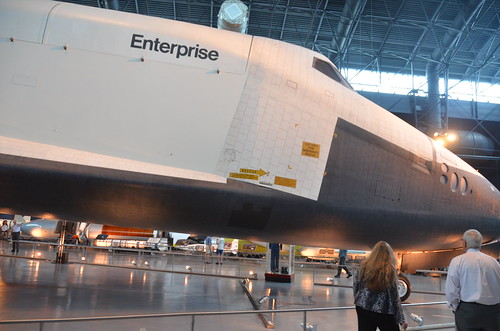
Image by Chris Devers


See much more photographs of this, and the Wikipedia article.


Specifics, quoting from Smithsonian National Air and Space Museum | Space Shuttle Enterprise:


Manufacturer:
Rockwell International Corporation


Nation of Origin:

United States of America


Dimensions:

All round: 57 ft. tall x 122 ft. lengthy x 78 ft. wing span, 150,000 lb.

(1737.36 x 3718.57 x 2377.44cm, 68039.6kg)


Materials:

Aluminum airframe and body with some fiberglass attributes payload bay doors are graphite epoxy composite thermal tiles are simulated (polyurethane foam) except for test samples of actual tiles and thermal blankets.


The initial Space Shuttle orbiter, &quotEnterprise,&quot is a full-scale test vehicle employed for flights in the atmosphere and tests on the ground it is not equipped for spaceflight. Though the airframe and flight control elements are like those of the Shuttles flown in space, this car has no propulsion program and only simulated thermal tiles due to the fact these attributes had been not required for atmospheric and ground tests. &quotEnterprise&quot was rolled out at Rockwell International’s assembly facility in Palmdale, California, in 1976. In 1977, it entered service for a nine-month-extended strategy-and-landing test flight system. Thereafter it was utilised for vibration tests and fit checks at NASA centers, and it also appeared in the 1983 Paris Air Show and the 1984 World’s Fair in New Orleans. In 1985, NASA transferred &quotEnterprise&quot to the Smithsonian Institution’s National Air and Space Museum.


Transferred from National Aeronautics and Space Administration


• • •


Quoting from Wikipedia | Space Shuttle Enterprise:


The Space Shuttle Enterprise (NASA Orbiter Automobile Designation: OV-101) was the very first Space Shuttle orbiter. It was constructed for NASA as element of the Space Shuttle program to execute test flights in the atmosphere. It was constructed without having engines or a functional heat shield, and was therefore not capable of spaceflight.


Originally, Enterprise had been intended to be refitted for orbital flight, which would have created it the second space shuttle to fly soon after Columbia. Even so, during the construction of Columbia, information of the final style changed, particularly with regard to the weight of the fuselage and wings. Refitting Enterprise for spaceflight would have involved dismantling the orbiter and returning the sections to subcontractors across the country. As this was an pricey proposition, it was determined to be significantly less expensive to develop Challenger around a physique frame (STA-099) that had been designed as a test post. Similarly, Enterprise was deemed for refit to replace Challenger following the latter was destroyed, but Endeavour was constructed from structural spares instead.


Service


Construction started on the very first orbiter on June four, 1974. Designated OV-101, it was originally planned to be named Constitution and unveiled on Constitution Day, September 17, 1976. A create-in campaign by Trekkies to President Gerald Ford asked that the orbiter be named after the Starship Enterprise, featured on the television show Star Trek. Although Ford did not mention the campaign, the president—who throughout Globe War II had served on the aircraft carrier USS&nbspMonterey&nbsp(CVL-26) that served with USS&nbspEnterprise&nbsp(CV-6)—said that he was &quotpartial to the name&quot and overrode NASA officials.


The design of OV-101 was not the exact same as that planned for OV-102, the first flight model the tail was constructed differently, and it did not have the interfaces to mount OMS pods. A big number of subsystems—ranging from main engines to radar equipment—were not installed on this vehicle, but the capacity to add them in the future was retained. As an alternative of a thermal protection program, its surface was mostly fiberglass.


In mid-1976, the orbiter was utilized for ground vibration tests, permitting engineers to evaluate information from an actual flight vehicle with theoretical models.


On September 17, 1976, Enterprise was rolled out of Rockwell’s plant at Palmdale, California. In recognition of its fictional namesake, Star Trek creator Gene Roddenberry and most of the principal cast of the original series of Star Trek have been on hand at the dedication ceremony.


Method and landing tests (ALT)


Major write-up: Strategy and Landing Tests


On January 31, 1977, it was taken by road to Dryden Flight Research Center at Edwards Air Force Base, to commence operational testing.


Although at NASA Dryden, Enterprise was used by NASA for a range of ground and flight tests intended to validate elements of the shuttle plan. The initial nine-month testing period was referred to by the acronym ALT, for &quotApproach and Landing Test&quot. These tests incorporated a maiden &quotflight&quot on February 18, 1977 atop a Boeing 747 Shuttle Carrier Aircraft (SCA) to measure structural loads and ground handling and braking traits of the mated method. Ground tests of all orbiter subsystems have been carried out to verify functionality prior to atmospheric flight.


The mated Enterprise/SCA combination was then subjected to five test flights with Enterprise unmanned and unactivated. The objective of these test flights was to measure the flight qualities of the mated mixture. These tests were followed with three test flights with Enterprise manned to test the shuttle flight manage systems.


Enterprise underwent five cost-free flights where the craft separated from the SCA and was landed beneath astronaut handle. These tests verified the flight qualities of the orbiter style and were carried out below numerous aerodynamic and weight configurations. On the fifth and final glider flight, pilot-induced oscillation issues have been revealed, which had to be addressed ahead of the very first orbital launch occurred.


On August 12, 1977, the space shuttle Enterprise flew on its personal for the initial time.


Preparation for STS-1


Following the ALT plan, Enterprise was ferried among several NASA facilities to configure the craft for vibration testing. In June 1979, it was mated with an external tank and solid rocket boosters (known as a boilerplate configuration) and tested in a launch configuration at Kennedy Space Center Launch Pad 39A.


Retirement


With the completion of vital testing, Enterprise was partially disassembled to allow specific elements to be reused in other shuttles, then underwent an international tour visiting France, Germany, Italy, the United Kingdom, Canada, and the U.S. states of California, Alabama, and Louisiana (in the course of the 1984 Louisiana World Exposition). It was also used to match-check the never-utilised shuttle launch pad at Vandenberg AFB, California. Lastly, on November 18, 1985, Enterprise was ferried to Washington, D.C., where it became property of the Smithsonian Institution.


Post-Challenger


Soon after the Challenger disaster, NASA regarded as employing Enterprise as a replacement. However refitting the shuttle with all of the necessary gear required for it to be utilized in space was considered, but alternatively it was decided to use spares constructed at the identical time as Discovery and Atlantis to develop Endeavour.


Post-Columbia


In 2003, right after the breakup of Columbia in the course of re-entry, the Columbia Accident Investigation Board performed tests at Southwest Research Institute, which used an air gun to shoot foam blocks of similar size, mass and speed to that which struck Columbia at a test structure which mechanically replicated the orbiter wing major edge. They removed a fiberglass panel from Enterprise’s wing to perform analysis of the material and attached it to the test structure, then shot a foam block at it. Even though the panel was not broken as a outcome of the test, the influence was sufficient to permanently deform a seal. As the reinforced carbon-carbon (RCC) panel on Columbia was 2.five occasions weaker, this recommended that the RCC major edge would have been shattered. Further tests on the fiberglass had been canceled in order not to threat damaging the test apparatus, and a panel from Discovery was tested to determine the effects of the foam on a similarly-aged RCC leading edge. On July 7, 2003, a foam influence test designed a hole 41&nbspcm by 42.five&nbspcm (16.1&nbspinches by 16.7&nbspinches) in the protective RCC panel. The tests clearly demonstrated that a foam impact of the sort Columbia sustained could seriously breach the protective RCC panels on the wing leading edge.


The board determined that the probable trigger of the accident was that the foam effect triggered a breach of a reinforced carbon-carbon panel along the major edge of Columbia’s left wing, permitting hot gases generated for the duration of re-entry to enter the wing and trigger structural collapse. This caused Columbia to spin out of handle, breaking up with the loss of the entire crew.


Museum exhibit


Enterprise was stored at the Smithsonian’s hangar at Washington Dulles International Airport just before it was restored and moved to the newly constructed Smithsonian’s National Air and Space Museum‘s Steven F. Udvar-Hazy Center at Dulles International Airport, where it has been the centerpiece of the space collection. On April 12, 2011, NASA announced that Space Shuttle Discovery, the most traveled orbiter in the fleet, will be added to the collection when the Shuttle fleet is retired. When that occurs, Enterprise will be moved to the Intrepid Sea-Air-Space Museum in New York City, to a newly constructed hangar adjacent to the museum. In preparation for the anticipated relocation, engineers evaluated the vehicle in early 2010 and determined that it was secure to fly on the Shuttle Carrier Aircraft after once more.

Tuesday, October 6, 2015

Steven F. Udvar-Hazy Center: P-40 Warhawk & F-4 Corsair hanging more than the SR-71 Blackbird, amongst other folks

Some cool machined components companies photos:


Steven F. Udvar-Hazy Center: P-40 Warhawk & F-4 Corsair hanging over the SR-71 Blackbird, amongst other folks

Image by Chris Devers

Quoting Smithsonian National Air and Space Museum | Curtiss P-40E Warhawk (Kittyhawk IA):


Whether or not identified as the Warhawk, Tomahawk, or Kittyhawk, the Curtiss P-40 proved to be a profitable, versatile fighter in the course of the very first half of World War II. The shark-mouthed Tomahawks that Gen. Claire Chennault’s &quotFlying Tigers&quot flew in China against the Japanese stay among the most popular airplanes of the war. P-40E pilot Lt. Boyd D. Wagner became the very first American ace of Globe War II when he shot down six Japanese aircraft in the Philippines in mid-December 1941.


Curtiss-Wright constructed this airplane as Model 87-A3 and delivered it to Canada as a Kittyhawk I in 1941. It served till 1946 in No. 111 Squadron, Royal Canadian Air Force. U.S. Air Force personnel at Andrews Air Force Base restored it in 1975 to represent an aircraft of the 75th Fighter Squadron, 23rd Fighter Group, 14th Air Force.


Donated by the Exchange Club in Memory of Kellis Forbes.


Manufacturer:
Curtiss Aircraft Firm


Date:

1939


Nation of Origin:

United States of America


Dimensions:

All round: 330 x 970cm, 2686kg, 1140cm (10ft 9 15/16in. x 31ft 9 7/8in., 5921.6lb., 37ft four 13/16in.)


Supplies:

All-metal, semi-monocoque


Physical Description:

Single engine, single seat, fighter aircraft.


• • • • •


See much more images of this, and the Wikipedia article.


Details, quoting from Smithsonian National Air and Space Museum | Lockheed SR-71 Blackbird:


No reconnaissance aircraft in history has operated globally in more hostile airspace or with such total impunity than the SR-71, the world’s quickest jet-propelled aircraft. The Blackbird’s functionality and operational achievements placed it at the pinnacle of aviation technology developments for the duration of the Cold War.


This Blackbird accrued about two,800 hours of flight time throughout 24 years of active service with the U.S. Air Force. On its last flight, March 6, 1990, Lt. Col. Ed Yielding and Lt. Col. Joseph Vida set a speed record by flying from Los Angeles to Washington, D.C., in 1 hour, 4 minutes, and 20 seconds, averaging 3,418 kilometers (2,124 miles) per hour. At the flight’s conclusion, they landed at Washington-Dulles International Airport and turned the airplane over to the Smithsonian.


Transferred from the United States Air Force.


Manufacturer:
Lockheed Aircraft Corporation


Designer:
Clarence L. &quotKelly&quot Johnson


Date:

1964


Country of Origin:

United States of America


Dimensions:

All round: 18ft five 15/16in. x 55ft 7in. x 107ft 5in., 169998.5lb. (5.638m x 16.942m x 32.741m, 77110.8kg)

Other: 18ft 5 15/16in. x 107ft 5in. x 55ft 7in. (5.638m x 32.741m x 16.942m)


Components:

Titanium


Physical Description:

Twin-engine, two-seat, supersonic strategic reconnaissance aircraft airframe constructed largley of titanium and its alloys vertical tail fins are constructed of a composite (laminated plastic-kind material) to reduce radar cross-section Pratt and Whitney J58 (JT11D-20B) turbojet engines feature massive inlet shock cones.


• • • • •


Quoting Smithsonian National Air and Space Museum | Vought F4U-1D Corsair :


By V-J Day, September 2, 1945, Corsair pilots had amassed an 11:1 kill ratio against enemy aircraft. The aircraft’s distinctive inverted gull-wing style permitted ground clearance for the enormous, three-bladed Hamilton Common Hydromatic propeller, which spanned a lot more than four meters (13 feet). The Pratt and Whitney R-2800 radial engine and Hydromatic propeller was the largest and one particular of the most strong engine-propeller combinations ever flown on a fighter aircraft.


Charles Lindbergh flew bombing missions in a Corsair with Marine Air Group 31 against Japanese strongholds in the Pacific in 1944. This airplane is painted in the colors and markings of the Corsair Sun Setter, a Marine close-help fighter assigned to the USS Essex in July 1944.


Transferred from the United States Navy.


Manufacturer:
Vought Aircraft Business


Date:

1940


Country of Origin:

United States of America


Dimensions:

All round: 460 x 1020cm, 4037kg, 1250cm (15ft 1 1/8in. x 33ft 5 9/16in., 8900lb., 41ft 1/8in.)


Supplies:

All metal with fabric-covered wings behind the primary spar.


Physical Description:

R-2800 radial air-cooled engine with 1,850 horsepower, turned a three-blade Hamilton Standard Hydromatic propeller with solid aluminum blades spanning 13 feet 1 inch wing bent gull-shaped on each sides of the fuselage.

Tuesday, September 1, 2015

Steven F. Udvar-Hazy Center: B-29 Superfortress "Enola Gay" panorama

Check out these precision machined components companies images:


Steven F. Udvar-Hazy Center: B-29 Superfortress “Enola Gay” panorama

Image by Chris Devers

Quoting Smithsonian National Air and Space Museum | Lockheed P-38J-10-LO Lightning:


In the P-38 Lockheed engineer Clarence &quotKelly&quot Johnson and his team of designers produced 1 of the most productive twin-engine fighters ever flown by any nation. From 1942 to 1945, U. S. Army Air Forces pilots flew P-38s over Europe, the Mediterranean, and the Pacific, and from the frozen Aleutian Islands to the sun-baked deserts of North Africa. Lightning pilots in the Pacific theater downed a lot more Japanese aircraft than pilots flying any other Allied warplane.


Maj. Richard I. Bong, America’s top fighter ace, flew this P-38J-10-LO on April 16, 1945, at Wright Field, Ohio, to evaluate an experimental approach of interconnecting the movement of the throttle and propeller manage levers. Nevertheless, his appropriate engine exploded in flight just before he could conduct the experiment.


Transferred from the United States Air Force.


Manufacturer:
Lockheed Aircraft Firm


Date:

1943


Nation of Origin:

United States of America


Dimensions:

All round: 390 x 1170cm, 6345kg, 1580cm (12ft 9 9/16in. x 38ft 4 five/8in., 13988.2lb., 51ft 10 1/16in.)


Materials:

All-metal


Physical Description:

Twin-tail boom and twin-engine fighter tricycle landing gear.


• • • • •


Quoting Smithsonian National Air and Space Museum | Boeing B-29 Superfortress &quotEnola Gay&quot:


Boeing’s B-29 Superfortress was the most sophisticated propeller-driven bomber of Globe War II and the very first bomber to home its crew in pressurized compartments. Despite the fact that developed to fight in the European theater, the B-29 identified its niche on the other side of the globe. In the Pacific, B-29s delivered a selection of aerial weapons: traditional bombs, incendiary bombs, mines, and two nuclear weapons.


On August six, 1945, this Martin-built B-29-45-MO dropped the initial atomic weapon utilized in combat on Hiroshima, Japan. 3 days later, Bockscar (on show at the U.S. Air Force Museum close to Dayton, Ohio) dropped a second atomic bomb on Nagasaki, Japan. Enola Gay flew as the advance weather reconnaissance aircraft that day. A third B-29, The Great Artiste, flew as an observation aircraft on each missions.


Transferred from the United States Air Force.


Manufacturer:
Boeing Aircraft Co.
Martin Co., Omaha, Nebr.


Date:

1945


Nation of Origin:

United States of America


Dimensions:

General: 900 x 3020cm, 32580kg, 4300cm (29ft 6 5/16in. x 99ft 1in., 71825.9lb., 141ft 15/16in.)


Materials:

Polished all round aluminum finish


Physical Description:

4-engine heavy bomber with semi-monoqoque fuselage and high-aspect ratio wings. Polished aluminum finish general, common late-Planet War II Army Air Forces insignia on wings and aft fuselage and serial number on vertical fin 509th Composite Group markings painted in black &quotEnola Gay&quot in black, block letters on reduce left nose.


Touring Numet Machining Methods, Inc. in Orange

Image by CT Senate Democrats

State Senator Gayle S. Slossberg tours Numet Machining Methods in Orange with Joseph Sartori, Numet’s Vice President of Operations. Numet is a manufacturer of precision machined components, and was capable to produce and retain jobs thanks to its participation in Connecticut’s Small Organization Express System and the Connecticut Insurance Reinvestment Fund. (October two, 2013)

Saturday, August 22, 2015

Steven F. Udvar-Hazy Center: South hangar panorama, like Vought OS2U-3 Kingfisher seaplane, B-29 Enola Gay, amongst others

Some cool precision element makers photos:


Steven F. Udvar-Hazy Center: South hangar panorama, which includes Vought OS2U-3 Kingfisher seaplane, B-29 Enola Gay, amongst other people


Image by Chris Devers

Quoting Smithsonian National Air and Space Museum | Vought OS2U-3 Kingfisher:


The Kingfisher was the U.S. Navy’s main ship-primarily based, scout and observation aircraft in the course of Planet War II. Revolutionary spot welding strategies gave it a smooth, non-buckling fuselage structure. Deflector plate flaps that hung from the wing’s trailing edge and spoiler-augmented ailerons functioned like further flaps to permit slower landing speeds. Most OS2Us operated in the Pacific, where they rescued numerous downed airmen, like Planet War I ace Eddie Rickenbacker and the crew of his B-17 Flying Fortress.


In March 1942, this airplane was assigned to the battleship USS Indiana. It later underwent a six-month overhaul in California, returned to Pearl Harbor, and rejoined the Indiana in March 1944. Lt. j.g. Rollin M. Batten Jr. was awarded the Navy Cross for making a daring rescue in this airplane below heavy enemy fire on July four, 1944.


Transferred from the United States Navy.


Manufacturer:
Vought-Sikorsky Aircraft Division


Date:

1937


Nation of Origin:

United States of America


Dimensions:

All round: 15ft 1 1/8in. x 33ft 9 1/2in., 4122.6lb., 36ft 1 1/16in. (460 x 1030cm, 1870kg, 1100cm)


Materials:

Wings covered with fabric aft of the main spar


Physical Description:

Two-seat monoplane, deflector plate flaps hung from the trailing edge of the wing, ailerons drooped at low airspeeds to function like extra flaps, spoilers.


• • • • •


Quoting Smithsonian National Air and Space Museum | Boeing B-29 Superfortress &quotEnola Gay&quot:


Boeing’s B-29 Superfortress was the most sophisticated propeller-driven bomber of World War II and the initial bomber to residence its crew in pressurized compartments. Although designed to fight in the European theater, the B-29 identified its niche on the other side of the globe. In the Pacific, B-29s delivered a range of aerial weapons: traditional bombs, incendiary bombs, mines, and two nuclear weapons.


On August six, 1945, this Martin-constructed B-29-45-MO dropped the initial atomic weapon used in combat on Hiroshima, Japan. Three days later, Bockscar (on show at the U.S. Air Force Museum close to Dayton, Ohio) dropped a second atomic bomb on Nagasaki, Japan. Enola Gay flew as the advance climate reconnaissance aircraft that day. A third B-29, The Wonderful Artiste, flew as an observation aircraft on each missions.


Transferred from the United States Air Force.


Manufacturer:
Boeing Aircraft Co.
Martin Co., Omaha, Nebr.


Date:

1945


Nation of Origin:

United States of America


Dimensions:

All round: 900 x 3020cm, 32580kg, 4300cm (29ft six five/16in. x 99ft 1in., 71825.9lb., 141ft 15/16in.)


Components:

Polished overall aluminum finish


Physical Description:

Four-engine heavy bomber with semi-monoqoque fuselage and higher-aspect ratio wings. Polished aluminum finish general, common late-World War II Army Air Forces insignia on wings and aft fuselage and serial quantity on vertical fin 509th Composite Group markings painted in black &quotEnola Gay&quot in black, block letters on reduce left nose.


Steven F. Udvar-Hazy Center: South hangar panorama, including Vought OS2U-three Kingfisher seaplane, B-29 Enola Gay, among other folks


Image by Chris Devers

Quoting Smithsonian National Air and Space Museum | Vought OS2U-3 Kingfisher:


The Kingfisher was the U.S. Navy’s primary ship-based, scout and observation aircraft during Globe War II. Revolutionary spot welding strategies gave it a smooth, non-buckling fuselage structure. Deflector plate flaps that hung from the wing’s trailing edge and spoiler-augmented ailerons functioned like extra flaps to allow slower landing speeds. Most OS2Us operated in the Pacific, where they rescued many downed airmen, like Globe War I ace Eddie Rickenbacker and the crew of his B-17 Flying Fortress.


In March 1942, this airplane was assigned to the battleship USS Indiana. It later underwent a six-month overhaul in California, returned to Pearl Harbor, and rejoined the Indiana in March 1944. Lt. j.g. Rollin M. Batten Jr. was awarded the Navy Cross for generating a daring rescue in this airplane under heavy enemy fire on July four, 1944.


Transferred from the United States Navy.


Manufacturer:
Vought-Sikorsky Aircraft Division


Date:

1937


Nation of Origin:

United States of America


Dimensions:

All round: 15ft 1 1/8in. x 33ft 9 1/2in., 4122.6lb., 36ft 1 1/16in. (460 x 1030cm, 1870kg, 1100cm)


Supplies:

Wings covered with fabric aft of the major spar


Physical Description:

Two-seat monoplane, deflector plate flaps hung from the trailing edge of the wing, ailerons drooped at low airspeeds to function like extra flaps, spoilers.

Sunday, July 5, 2015

Steven F. Udvar-Hazy Center: View down onto SR-71 Blackbird & Boeing P-26A Peashooter

Check out these surface grinding aluminum photos:


Steven F. Udvar-Hazy Center: View down onto SR-71 Blackbird & Boeing P-26A Peashooter


Image by Chris Devers
See a lot more photos of this, and the Wikipedia write-up.


Specifics, quoting from Smithsonian National Air and Space Museum | Boeing P-26A Peashooter:


The Boeing P-26A of the mid-to-late 1930s introduced the notion of the high-overall performance, all-metal monoplane fighter design and style, which would grow to be regular throughout World War II. A radical departure from wood-and-fabric biplanes, the Peashooter nonetheless retained an open cockpit, fixed landing gear, and external wing bracing.


Most P-26As stationed overseas had been ultimately sold to the Philippines or assigned to the Panama Canal Division Air Force, a branch of the U.S. Army Air Corps. Numerous went to China and one to Spain. This a single was primarily based at Selfridge Field in Michigan and Fairfield Air Depot in Ohio among its acceptance by the U.S. Army Air Corps in 1934 and its transfer to the Canal Zone in 1938. It was provided to Guatemala in 1942 and flew in the Guatemalan air force until 1954. Guatemala donated it to the Smithsonian in 1957.


Present of the Guatemalan Air Force, Republic of Guatemala


Manufacturer:
Boeing Aircraft Co.


Date:

1934


Nation of Origin:

United States of America


Dimensions:

Wingspan: eight.5 m (27 ft 11 in)

Length:7.three m (23 ft 11 in)

Height:three.1 m (10 ft 2 in)

Weight, empty:996 kg (two,196 lb)

Weight, gross:1,334 kg (two,935 lb)

Top speed:377 km/h (234 mph)

Engine:Pratt &amp Whitney R-1340-27, 600 hp

Armament:two .30 cal. M2 Browning aircraft machine guns


• • •


Quoting from Boeing History | P-26 &quotPeashooter&quot Fighter:


The all-metal, single-wing P-26, popularly identified as the &quotPeashooter,&quot was an totally new design and style for Boeing, and its structure drew heavily on the Monomail. The Peashooter’s wings have been braced with wire, rather than with the rigid struts utilised on other airplanes, so the airplane was lighter and had much less drag. Its initial high landing speeds have been lowered by the addition of wing flaps in the production models.


Since the P-26 flew 27 mph faster and outclimbed biplane fighters, the Army ordered 136 production-model Peashooters. Acclaimed by pilots for its speed and maneuverability, the modest but feisty P-26 formed the core of pursuit squadrons all through the United States.


Twelve export versions, 11 for China and 1 for Spain, were built. One of a group of P-26s, turned more than to the Philippine Army late in 1941, was among the first Allied fighters to down a Japanese airplane in Globe War II.


Funds to purchase the export version of the Peashooter have been partly raised by Chinese Americans. Contribution boxes were placed on the counters of Chinese restaurants.


Specifications


• 1st flight: March 20, 1932

• Model quantity: 248/266

• Classification: Fighter

• Span: 28 feet

• Length: 23 feet 7 inches

• Gross weight: 2,995 pounds

• Leading speed: 234 mph

• Cruising speed: 200 mph

• Range: 635 miles

• Ceiling: 27,400 feet

• Power: 600-horsepower P&ampW Wasp engine

• Accommodation: 1 pilot

• Armament: two machine guns, 200-pound bomb load


• • • • •


See far more pictures of this, and the Wikipedia article.


Details, quoting from Smithsonian National Air and Space Museum | Lockheed SR-71 Blackbird:


No reconnaissance aircraft in history has operated globally in a lot more hostile airspace or with such full impunity than the SR-71, the world’s fastest jet-propelled aircraft. The Blackbird’s efficiency and operational achievements placed it at the pinnacle of aviation technologies developments during the Cold War.


This Blackbird accrued about 2,800 hours of flight time throughout 24 years of active service with the U.S. Air Force. On its last flight, March 6, 1990, Lt. Col. Ed Yielding and Lt. Col. Joseph Vida set a speed record by flying from Los Angeles to Washington, D.C., in 1 hour, four minutes, and 20 seconds, averaging 3,418 kilometers (two,124 miles) per hour. At the flight’s conclusion, they landed at Washington-Dulles International Airport and turned the airplane more than to the Smithsonian.


Transferred from the United States Air Force.


Manufacturer:
Lockheed Aircraft Corporation


Designer:
Clarence L. &quotKelly&quot Johnson


Date:

1964


Country of Origin:

United States of America


Dimensions:

General: 18ft 5 15/16in. x 55ft 7in. x 107ft 5in., 169998.5lb. (5.638m x 16.942m x 32.741m, 77110.8kg)

Other: 18ft 5 15/16in. x 107ft 5in. x 55ft 7in. (5.638m x 32.741m x 16.942m)


Materials:

Titanium


Physical Description:

Twin-engine, two-seat, supersonic strategic reconnaissance aircraft airframe constructed largley of titanium and its alloys vertical tail fins are constructed of a composite (laminated plastic-type material) to lessen radar cross-section Pratt and Whitney J58 (JT11D-20B) turbojet engines feature huge inlet shock cones.


Extended Description:

No reconnaissance aircraft in history has operated in more hostile airspace or with such total impunity than the SR-71 Blackbird. It is the fastest aircraft propelled by air-breathing engines. The Blackbird’s efficiency and operational achievements placed it at the pinnacle of aviation technologies developments throughout the Cold War. The airplane was conceived when tensions with communist Eastern Europe reached levels approaching a full-blown crisis in the mid-1950s. U.S. military commanders desperately necessary accurate assessments of Soviet worldwide military deployments, especially close to the Iron Curtain. Lockheed Aircraft Corporation’s subsonic U-two (see NASM collection) reconnaissance aircraft was an able platform but the U. S. Air Force recognized that this comparatively slow aircraft was already vulnerable to Soviet interceptors. They also understood that the fast improvement of surface-to-air missile systems could place U-2 pilots at grave risk. The danger proved reality when a U-2 was shot down by a surface to air missile more than the Soviet Union in 1960.


Lockheed’s first proposal for a new higher speed, higher altitude, reconnaissance aircraft, to be capable of avoiding interceptors and missiles, centered on a design and style propelled by liquid hydrogen. This proved to be impracticable since of considerable fuel consumption. Lockheed then reconfigured the style for conventional fuels. This was feasible and the Central Intelligence Agency (CIA), already flying the Lockheed U-2, issued a production contract for an aircraft designated the A-12. Lockheed’s clandestine ‘Skunk Works’ division (headed by the gifted style engineer Clarence L. &quotKelly&quot Johnson) developed the A-12 to cruise at Mach 3.2 and fly properly above 18,288 m (60,000 feet). To meet these challenging specifications, Lockheed engineers overcame a lot of daunting technical challenges. Flying much more than three instances the speed of sound generates 316° C (600° F) temperatures on external aircraft surfaces, which are adequate to melt traditional aluminum airframes. The design and style team chose to make the jet’s external skin of titanium alloy to which shielded the internal aluminum airframe. Two standard, but really potent, afterburning turbine engines propelled this exceptional aircraft. These power plants had to operate across a enormous speed envelope in flight, from a takeoff speed of 334 kph (207 mph) to more than three,540 kph (two,200 mph). To avert supersonic shock waves from moving inside the engine intake causing flameouts, Johnson’s group had to design a complicated air intake and bypass technique for the engines.


Skunk Operates engineers also optimized the A-12 cross-section design and style to exhibit a low radar profile. Lockheed hoped to achieve this by cautiously shaping the airframe to reflect as small transmitted radar power (radio waves) as achievable, and by application of special paint made to absorb, rather than reflect, these waves. This treatment became a single of the 1st applications of stealth technology, but it by no means fully met the design objectives.


Test pilot Lou Schalk flew the single-seat A-12 on April 24, 1962, after he became airborne accidentally in the course of high-speed taxi trials. The airplane showed great promise but it necessary considerable technical refinement just before the CIA could fly the initial operational sortie on Might 31, 1967 – a surveillance flight over North Vietnam. A-12s, flown by CIA pilots, operated as portion of the Air Force’s 1129th Particular Activities Squadron below the &quotOxcart&quot program. Although Lockheed continued to refine the A-12, the U. S. Air Force ordered an interceptor version of the aircraft designated the YF-12A. The Skunk Performs, nonetheless, proposed a &quotspecific mission&quot version configured to conduct post-nuclear strike reconnaissance. This system evolved into the USAF’s familiar SR-71.


Lockheed constructed fifteen A-12s, including a special two-seat trainer version. Two A-12s were modified to carry a particular reconnaissance drone, designated D-21. The modified A-12s were redesignated M-21s. These had been developed to take off with the D-21 drone, powered by a Marquart ramjet engine mounted on a pylon amongst the rudders. The M-21 then hauled the drone aloft and launched it at speeds higher enough to ignite the drone’s ramjet motor. Lockheed also constructed 3 YF-12As but this sort never ever went into production. Two of the YF-12As crashed throughout testing. Only a single survives and is on show at the USAF Museum in Dayton, Ohio. The aft section of 1 of the &quotwritten off&quot YF-12As which was later utilised along with an SR-71A static test airframe to manufacture the sole SR-71C trainer. A single SR-71 was lent to NASA and designated YF-12C. Including the SR-71C and two SR-71B pilot trainers, Lockheed constructed thirty-two Blackbirds. The first SR-71 flew on December 22, 1964. Because of extreme operational costs, military strategists decided that the more capable USAF SR-71s should replace the CIA’s A-12s. These had been retired in 1968 following only one particular year of operational missions, mostly over southeast Asia. The Air Force’s 1st Strategic Reconnaissance Squadron (portion of the 9th Strategic Reconnaissance Wing) took over the missions, flying the SR-71 starting in the spring of 1968.


Soon after the Air Force began to operate the SR-71, it acquired the official name Blackbird– for the unique black paint that covered the airplane. This paint was formulated to absorb radar signals, to radiate some of the tremendous airframe heat generated by air friction, and to camouflage the aircraft against the dark sky at higher altitudes.


Experience gained from the A-12 program convinced the Air Force that flying the SR-71 safely necessary two crew members, a pilot and a Reconnaissance Systems Officer (RSO). The RSO operated with the wide array of monitoring and defensive systems installed on the airplane. This equipment included a sophisticated Electronic Counter Measures (ECM) technique that could jam most acquisition and targeting radar. In addition to an array of sophisticated, higher-resolution cameras, the aircraft could also carry gear created to record the strength, frequency, and wavelength of signals emitted by communications and sensor devices such as radar. The SR-71 was designed to fly deep into hostile territory, avoiding interception with its tremendous speed and higher altitude. It could operate safely at a maximum speed of Mach three.three at an altitude far more than sixteen miles, or 25,908 m (85,000 ft), above the earth. The crew had to wear pressure suits comparable to these worn by astronauts. These suits have been needed to shield the crew in the occasion of sudden cabin pressure loss even though at operating altitudes.


To climb and cruise at supersonic speeds, the Blackbird’s Pratt &amp Whitney J-58 engines were developed to operate constantly in afterburner. Whilst this would seem to dictate higher fuel flows, the Blackbird actually achieved its greatest &quotgas mileage,&quot in terms of air nautical miles per pound of fuel burned, for the duration of the Mach three+ cruise. A typical Blackbird reconnaissance flight might call for numerous aerial refueling operations from an airborne tanker. Each time the SR-71 refueled, the crew had to descend to the tanker’s altitude, normally about six,000 m to 9,000 m (20,000 to 30,000 ft), and slow the airplane to subsonic speeds. As velocity decreased, so did frictional heat. This cooling impact triggered the aircraft’s skin panels to shrink considerably, and these covering the fuel tanks contracted so significantly that fuel leaked, forming a distinctive vapor trail as the tanker topped off the Blackbird. As quickly as the tanks have been filled, the jet’s crew disconnected from the tanker, relit the afterburners, and once more climbed to higher altitude.


Air Force pilots flew the SR-71 from Kadena AB, Japan, throughout its operational career but other bases hosted Blackbird operations, as well. The 9th SRW occasionally deployed from Beale AFB, California, to other places to carryout operational missions. Cuban missions were flown straight from Beale. The SR-71 did not begin to operate in Europe until 1974, and then only temporarily. In 1982, when the U.S. Air Force based two aircraft at Royal Air Force Base Mildenhall to fly monitoring mission in Eastern Europe.


When the SR-71 became operational, orbiting reconnaissance satellites had already replaced manned aircraft to collect intelligence from internet sites deep within Soviet territory. Satellites could not cover each geopolitical hotspot so the Blackbird remained a vital tool for worldwide intelligence gathering. On many occasions, pilots and RSOs flying the SR-71 offered details that proved important in formulating successful U. S. foreign policy. Blackbird crews supplied important intelligence about the 1973 Yom Kippur War, the Israeli invasion of Lebanon and its aftermath, and pre- and post-strike imagery of the 1986 raid performed by American air forces on Libya. In 1987, Kadena-primarily based SR-71 crews flew a number of missions more than the Persian Gulf, revealing Iranian Silkworm missile batteries that threatened industrial shipping and American escort vessels.


As the performance of space-primarily based surveillance systems grew, along with the effectiveness of ground-primarily based air defense networks, the Air Force began to drop enthusiasm for the costly program and the 9th SRW ceased SR-71 operations in January 1990. Despite protests by military leaders, Congress revived the plan in 1995. Continued wrangling over operating budgets, however, soon led to final termination. The National Aeronautics and Space Administration retained two SR-71As and the a single SR-71B for higher-speed analysis projects and flew these airplanes till 1999.


On March 6, 1990, the service profession of a single Lockheed SR-71A Blackbird ended with a record-setting flight. This unique airplane bore Air Force serial number 64-17972. Lt. Col. Ed Yeilding and his RSO, Lieutenant Colonel Joseph Vida, flew this aircraft from Los Angeles to Washington D.C. in 1 hour, 4 minutes, and 20 seconds, averaging a speed of 3,418 kph (2,124 mph). At the conclusion of the flight, ‘972 landed at Dulles International Airport and taxied into the custody of the Smithsonian’s National Air and Space Museum. At that time, Lt. Col. Vida had logged 1,392.7 hours of flight time in Blackbirds, much more than that of any other crewman.


This specific SR-71 was also flown by Tom Alison, a former National Air and Space Museum’s Chief of Collections Management. Flying with Detachment 1 at Kadena Air Force Base, Okinawa, Alison logged more than a dozen ‘972 operational sorties. The aircraft spent twenty-four years in active Air Force service and accrued a total of 2,801.1 hours of flight time.


Wingspan: 55’7&quot

Length: 107’5&quot

Height: 18’6&quot

Weight: 170,000 Lbs


Reference and Additional Reading:


Crickmore, Paul F. Lockheed SR-71: The Secret Missions Exposed. Oxford: Osprey Publishing, 1996.


Francillon, Rene J. Lockheed Aircraft Because 1913. Annapolis, Md.: Naval Institute Press, 1987.


Johnson, Clarence L. Kelly: More Than My Share of It All. Washington D.C.: Smithsonian Institution Press, 1985.


Miller, Jay. Lockheed Martin’s Skunk Performs. Leicester, U.K.: Midland Counties Publishing Ltd., 1995.


Lockheed SR-71 Blackbird curatorial file, Aeronautics Division, National Air and Space Museum.


DAD, 11-11-01

Monday, September 29, 2014

Eurotech 710SLLY Multi Axis CNC Turning Center


Eurotech 710SLLY Mutli Axis CNC Turning Center with 24 Reside Tools completing a component.
Video Rating: 5 / 5


(Posted by an precision machining China Company and quality CNC machined parts China manufacturer and CNC machining services China supplier)

Monday, September 22, 2014

Nice Cnc Turning Center pictures

A handful of good cnc turning center images I located:


CNC Turning Center


Image by spangineer

A modest CNC turning center, in the Leonhard Building at Penn State.


On Wikimedia Commons
CNC


(Posted by an precision machining China Company and quality CNC machined parts China manufacturer and CNC machining services China supplier)

Saturday, September 13, 2014

Okuma&#39s New VTM-2000YB Multitasking CNC Turning Center Gives Heavy ...

Okuma"s New VTM-2000YB Multitasking CNC Turning Center Offers Heavy …

At IMTS 2014, Okuma will introduce its new VTM-2000YB multitasking CNC turning center, which offers heavy-duty construction for big parts machining. The extreme rigidity and effective cutting capabilities of this machine make it ideal for machining&nbsp…
Study much more on Robotics Tomorrow


The Dawn of the Sensible Factory

For instance, in CNC turning operations, a number of diverse machines are employed with an external controller, such as conveyors or robotic arms to move elements from machine to machine and align them under the guidance of industrial cameras before&nbsp…
Read a lot more on Quality Magazine


(Posted by an precision machining China Company and quality CNC machined parts China manufacturer and CNC machining services China supplier)

Friday, September 12, 2014

Additive Manufacturing Professional EOS Joins Commonwealth Center for Advanced ...

Additive Manufacturing Expert EOS Joins Commonwealth Center for Advanced …

In the case of a close to-net DMLS portion, a milling or CNC cutting procedure might be far more suitable. And the resulting production line may be … The 62,000 square-foot facility at the Center"s Prince George County property includes computational software program and …
Read far more on ENGINEERING.com


Rockwell and Fanuc announce international collaboration

Robomachines are Fanuc"s robotic machining centres, which contain injection moulding, vertical milling and EDM (electrical discharge machining) systems. The principal initial influence of the new collaboration is expected be in the automotive industry, exactly where …
Read a lot more on Drives & Controls


IMTS 2014 Conference: Re-evaluating the EDM Approach

Till not too long ago, several companies of titanium components have deemed electrical discharge machining (EDM), either fully off limits, or to be employed as a main process coupled with a secondary operation. A lot of instances, the secondary operation is&nbsp…
Read more on Today’s Power Solutions


CNC Software participates in 3rd annual MFG Day

Tolland, Connecticut – CNC Application, Inc., creators of Mastercam CAD/CAM software, will host an open residence at its manufacturing facility situated at 671 Old Post Road, Tolland, Conn. to celebrate Manufacturing Day. The open house will be held on Friday,&nbsp…
Read a lot more on Aerospace Manufacturing and Design and style


(Posted by an precision machining China Company and quality CNC machined parts China manufacturer and CNC machining services China supplier)

Saturday, September 6, 2014

Steven F. Udvar-Hazy Center: south hangar panorama, which includes B-29 Superfortress "Enola Gay", Grumman F6F-3 Hellcat, among other people

Check out these precision manufacturing business pictures:


Steven F. Udvar-Hazy Center: south hangar panorama, such as B-29 Superfortress “Enola Gay”, Grumman F6F-3 Hellcat, among other folks


Image by Chris Devers
See much more photos of this, and the Wikipedia report.


Particulars, quoting from Smithsonian National Air and Space Museum: Steven F. Udvar-Hazy | Boeing B-29 Superfortress &quotEnola Gay&quot:


Boeing’s B-29 Superfortress was the most sophisticated propeller-driven bomber of Planet War II and the 1st bomber to residence its crew in pressurized compartments. Although developed to fight in the European theater, the B-29 found its niche on the other side of the globe. In the Pacific, B-29s delivered a assortment of aerial weapons: traditional bombs, incendiary bombs, mines, and two nuclear weapons.


On August 6, 1945, this Martin-built B-29-45-MO dropped the very first atomic weapon employed in combat on Hiroshima, Japan. 3 days later, Bockscar (on show at the U.S. Air Force Museum near Dayton, Ohio) dropped a second atomic bomb on Nagasaki, Japan. Enola Gay flew as the advance climate reconnaissance aircraft that day. A third B-29, The Excellent Artiste, flew as an observation aircraft on both missions.


Transferred from the United States Air Force.


Manufacturer:
Boeing Aircraft Co.
Martin Co., Omaha, Nebr.


Date:

1945


Nation of Origin:

United States of America


Dimensions:

All round: 900 x 3020cm, 32580kg, 4300cm (29ft 6 5/16in. x 99ft 1in., 71825.9lb., 141ft 15/16in.)


Components:

Polished all round aluminum finish


Physical Description:

4-engine heavy bomber with semi-monoqoque fuselage and higher-aspect ratio wings. Polished aluminum finish general, standard late-Globe War II Army Air Forces insignia on wings and aft fuselage and serial quantity on vertical fin 509th Composite Group markings painted in black &quotEnola Gay&quot in black, block letters on reduced left nose.


• • • • •


See much more photos of this, and the Wikipedia write-up.


Particulars, quoting from Smithsonian National Air and Space Museum: Steven F. Udvar-Hazy | Grumman F6F-3 Hellcat:


The Grumman F6F Hellcat was originally conceived as an sophisticated version of the U.S. Navy’s then present front-line fighter, the F4F Wildcat (see NASM collection). The Wildcat’s intended replacement, the Vought F4U Corsair (see NASM collection), first flown in 1940, was showing excellent guarantee, but development was slowed by troubles, such as the crash of the prototype.


The National Air and Space Museum’s F6F-three Hellcat, BuNo. 41834, was built at Grumman’s Bethpage, New York, factory in February 1944 under contract NOA-(S)846. It was delivered to the Navy on February 7, and arrived in San Diego, California, on the 18th. It was assigned to Fighter Squadron 15 (VF-15) on USS Hornet (CV12) bound for Hawaii. On arrival, it was assigned to VF-3 where it sustained harm in a wheels-up landing at NAS Barbers Point, Hawaii. Right after repair, it was assigned to VF-83 where it was employed in a instruction part until February 21, 1945. Soon after many transfers 41834 was converted to an F6F-3K target drone with the installation of sophisticated radio-control equipment. It was painted red with a pink tail that carried the number 14. Its mission was to be employed in Operation Crossroads – the atomic bomb tests at Bikini Atoll. It flew on June 24, 1946, with a pilot, on a practice flight and was launched, unmanned, quickly after the initial bomb test. Instrumentation on board and photographic plates taped to the control stick obtained information on radioactivity. Three far more manned flights preceded the final unmanned flight on July 25, 1946, which evaluated the 1st underwater explosion. Records indicate that exposure of this aircraft to the radioactive cloud was minimal and residual radiation is negligible.


F6F-3K 41834 was transferred to NAS Norfolk and logged its last flight on March 25, 1947, with a total of 430.two flying hours. It was assigned to the National Air Museum on November 3, 1948, and remained at Norfolk till October 4, 1960, when it was moved by barge to Washington and placed in storage. In 1976 this Hellcat was loaned to the USS Yorktown Museum at Charleston, South Carolina. A superficial restoration was performed at the museum, but because of the harsh atmosphere and its poor situation the Hellcat was returned to NASM on March 16, 1982. In 1983, it was sent to Grumman Aerospace where a team of volunteers totally restored the aircraft. In 1985, it was shipped back to the Paul E. Garber Preservation, Restoration and Storage Facility in Suitland, Maryland, and place in storage. NASM’s F6F-3 Hellcat is scheduled to be displayed in the new Steven F. Udvar-Hazy center at Dulles International Airport in Virginia in 2004.


Transferred from the United States Navy.


Manufacturer:
Grumman Aircraft Engineering Corporation


Date:

1943


Nation of Origin:

United States of America


Dimensions:

All round: 338 x 1021cm, 4092kg, 1304cm (11ft 1 1/16in. x 33ft five 15/16in., 9021.2lb., 42ft 9 3/8in.)


Physical Description:

Heavy armor plate, reinforced empennage, R-2800-10W engine, spring tabs on the ailerons (enhanced maneuverability), could carry rockets as effectively as bombs.


(Posted by an precision machining China Company and quality CNC machined parts China manufacturer and CNC machining services China supplier)

Tuesday, August 26, 2014

CNC China Turning Center DX 200 - JYOTI


P & R started its CNC machining workshop in 1999 from Bhavnagar (Gujarat India). Our company has established itself as the leading manufacturer and supplier …

MORI SEIKI SL-2 CNC LATHE TURNING CENTER with FANUC CONTROLS

Most popular cnc lathe turning eBay auctions:


MORI SEIKI SL-2 CNC LATHE TURNING CENTER with FANUC CONTROLS


$8,250.00
End Date: Wednesday Sep-24-2014 8:07:20 PDT
Buy It Now for only: $8,250.00
Buy It Now | Add to watch list


GT Xpress / Prodigy CNC Turning Center ( Lathe )


$2,000.00 (1 Bid)
End Date: Friday Aug-29-2014 15:48:26 PDT
Bid now | Add to watch list


MAZAK SLANT TURN 25 UNIVERSAL CNC LATHE TURNING CENTER 3.15" BORE HOL HAAS VIDEO


$24,999.99
End Date: Thursday Sep-25-2014 8:47:04 PDT
Buy It Now for only: $24,999.99
Buy It Now | Add to watch list

Friday, August 22, 2014

Okuma Howa ACT 35 CNC China Lathe China Turning Center Fanuc 18T Control Tailstock 12" Chuck

Most popular cnc turning eBay auctions:


Okuma Howa ACT 35 CNC Lathe Turning Center Fanuc 18T Control Tailstock 12" Chuck


$27,500.00
End Date: Friday Sep-19-2014 7:15:59 PDT
Buy It Now for only: $27,500.00
Buy It Now | Add to watch list


SUPERMAX TC2, CNC 2 Axis Turning Center, FANUC OT Control,


$9,950.00
End Date: Sunday Aug-31-2014 15:42:50 PDT
Buy It Now for only: $9,950.00
Buy It Now | Add to watch list