Showing posts with label Nice. Show all posts

Saturday, November 7, 2015

Nice Machining Suppliers images

A couple of nice machining suppliers images I located:


A Bitcoin You Can Flip

Image by jurvetson

My son has grow to be fascinated with bitcoins, and so I had to get him a tangible a single for Xmas (thanks Sim1!). The public key is imprinted visibly on the tamper-evident holographic film, and the private essential lies underneath.


I too was fascinated by digital money back in college, and much more specifically by the asymmetric mathematical transforms underlying public-important crypto and digital blind signatures.


I remembered a technical paper I wrote, but could not find it. A desktop search revealed an essay that I totally forgot, anything that I had recovered from my archives of floppy discs (while I nevertheless could).


It is an write-up I wrote for the college newspaper in 1994. Ironically, Microsoft Word could not open this ancient Microsoft Word file format, but the free of charge text editors could.


What a fun time capsule, beneath, with some option naivetés…


I am trying to reconstruct what I was thinking, and asking yourself if it tends to make any sense. I think I was arguing that a bulletproof framework for digital money (and what far better testing ground) could be utilized to secure a digital container for executable code on a rental basis. So the expression of an notion — the distinct code, or runtime service — is locked in a safe container. The notion would be to avoid copying rather of punishing following the reality. Micro-currency and micro-code appear like equivalent exercises in regulating the single use of an issued quantity.


Now that the Bitcoin experiment is underway, do you know of anybody writing about it as an option framework for intellectual property?


IP and Digital Money

@Normal:
Digital Money and the “Intellectual Property” Oxymoron

By Steve Jurvetson


Many of us will soon be working in the details solutions or technologies industries which are currently tangled in a bramble patch of intellectual home law. As the law struggles to discover coherency and an internally-consistent logic for intellectual house (IP) protection, digital encryption technologies might offer a much better remedy — from the point of view of lowering litigation, exploiting the inherent rewards of an data-primarily based company model, and preserving a free economy of ideas.

Bullet-proof digital cash technology, which is now emerging, can supply a protected “cryptographic container” for intellectual expressions, thereby preserving conventional notions of intellectual house that shield particular instantiations of an thought rather than the thought itself. For example, it seems affordable that Intuit need to be capable to safeguard against the widespread duplication of their Quicken application (the expression of an concept), but they must not be capable to patent the underlying thought of single-entry bookkeeping. There are sturdy financial incentives for digital cash to develop and for those methods to be adapted for IP protection — to develop a protected container or expression of an idea. The speedy march of information technology has strained the evolution of IP law, but rather than patching the law, details technologies itself may possibly offer a much more coherent remedy.


Info Wants To Be Totally free

Presently, IP law is enigmatic due to the fact it is expanding to a domain for which it was not initially intended. In building the U.S. Constitution, Thomas Jefferson argued that suggestions should freely transverse the globe, and that tips were fundamentally different from material goods. He concluded that “Inventions then cannot, in nature, be a subject of home.” The troubles surrounding IP come into sharp focus as we shift to being much more of an data-primarily based economy.

The use of e-mail and local Tv footage assists disseminate details about the globe and can be a force for democracy — as observed in the Television footage from Chechen, the use of modems in Prague in the course of the Velvet Revolution, and the e-mail and Television from Tianammen Square. Even Gorbachev employed a video camera to show what was taking place after he was kidnapped. What seems to be an inherent force for democracy runs into issues when it becomes the subject of home.

As larger-level programming languages grow to be much more like organic languages, it will grow to be increasingly hard to distinguish the thought from the code. Language precedes believed, as Jean-Louis Gassée is fond of saying, and our language is the framework for the formulation and expression of our suggestions. Restricting software program will increasingly be indistinguishable from restricting freedom of speech.

An economy of ideas and human attention depends on the continuous and cost-free exchange of concepts. Because of the associative nature of memory processes, no notion is detached from other folks. This begs the query, is intellectual home an oxymoron?


Intellectual Home Law is a Patch

John Perry Barlow, former Grateful Dead lyricist and co-founder (with Mitch Kapor) of the Electronic Frontier Foundation, argues that “Intellectual home law can not be patched, retrofitted or expanded to contain digitized expression… Faith in law will not be an efficient strategy for higher-tech organizations. Law adapts by continuous increments and at a pace second only to geology. Technologies advances in lunging jerks. Real-globe situations will continue to change at a blinding pace, and the law will lag further behind, much more profoundly confused. This mismatch may prove impossible to overcome.”

From its origins in the Industrial Revolution where the invention of tools took on a new significance, patent and copyright law has protected the physical conveyance of an concept, and not the thought itself. The physical expression is like a container for an concept. But with the emerging info superhighway, the “container” is becoming far more ethereal, and it is disappearing altogether. Regardless of whether it is e-mail these days, or the future goods of the Info Age, the “expressions” of tips will be voltage situations darting about the net, very significantly like thoughts. The fleeting copy of an image in RAM is not quite different that the fleeting image on the retina.

The digitization of all forms of information — from books to songs to photos to multimedia — detaches information from the physical plane exactly where IP law has often identified definition and precedent. Patents can not be granted for abstract concepts or algorithms, however courts have lately upheld the patentability of application as lengthy as it is operating a physical machine or causing a physical outcome. Copyright law is even a lot more of a patch. The U.S. Copyright Act of 1976 calls for that operates be fixed in a durable medium, and where an idea and its expression are inseparable, the merger doctrine dictates that the expression can not be copyrighted. E-mail is not presently copyrightable due to the fact it is not a reduction to tangible form. So of course, there is a proposal to amend these copyright provisions. In current rulings, Lotus won its case that Borland’s Quattro Pro spreadsheet copied components of Lotus 123’s appear and feel, yet Apple lost a related case versus Microsoft and HP. As Professor Bagley points out in her new text, “It is tough to reconcile beneath the total idea and feel test the results in the Apple and Lotus instances.” Provided the inconsistencies and financial significance of these troubles, it is no surprise that swarms of lawyers are studying to practice in the IP arena.

Back in the early days of Microsoft, Bill Gates wrote an inflammatory “Open Letter to Hobbyists” in which he alleged that “most of you steal your software program … and need to be kicked out of any club meeting you show up at.” He presented the economic argument that piracy prevents correct profit streams and “prevents very good computer software from becoming written.” Now we have Windows.

But seriously, if we continue to believe that the worth of details is based on scarcity, as it is with physical objects, we will continue to patch laws that are contrary to the nature of details, which in several instances increases in worth with distribution. Small, fast moving organizations (like Netscape and Id) shield their ideas by getting to the marketplace quicker than their larger competitors who base their protection on fear and litigation.

The patent office is woefully understaffed and unable to judge the nuances of application. Comptons was initially granted a patent that covered virtually all multimedia technology. When they tried to collect royalties, Microsoft pushed the Patent Workplace to overturn the patent. In 1992, Computer software Marketing Corp received a patent for “displaying and integrating commercial ads with computer software.” That’s like patenting the concept of a radio industrial. In 1993, a DEC engineer received a patent on just two lines of machine code typically utilized in object-oriented programming. CompuServe announced this month that they plan to collect royalties on the extensively utilised GIF file format for images.

The Patent Office has issued properly more than 12,000 software program patents, and a programmer can unknowingly be in violation of any them. Microsoft had to spend 0MM to STAC in February 1994 for violating their patent on data compression. The penalties can be costly, but so can a patent search. Many of the application patents don’t have the words “computer,” “software,” “program,” or “algorithm” in their abstracts. “Software patents turn every single selection you make while writing a plan into a legal threat,” says Richard Stallman, founder of the League for Programming Freedom. “They make writing a huge system like crossing a minefield. Every single step has a little likelihood of stepping on a patent and blowing you up.” The really notion of seventeen years of patent protection in the quickly moving software market seems absurd. MS-DOS did not exist seventeen years ago.

IP law faces the further wrinkle of jurisdictional issues. Exactly where has an Web crime taken location? In the nation or state in which the laptop server resides? Many nations do not have the same intellectual house laws as the U.S. Even inside the U.S., the law can be challenging to enforce for instance, a group of music publishers sued CompuServe for the digital distribution of copyrighted music. A complication is that CompuServe has no understanding of the activity because it happens in the flood of bits transferring in between its subscribers

The tension noticed in creating digital copies revolves around the concern of home. But as opposed to the theft of material goods, copying does not deprive the owner of their possessions. With digital piracy, it is significantly less a clear ethical issue of theft, and much more an abstract notion that you are undermining the company model of an artist or computer software developer. The distinction among ethics and laws often revolves about their enforceability. Ahead of copy machines, it was challenging to make a book, and so it was apparent and visible if someone was copying your function. In the digital age, copying is lightning quickly and tough to detect. Offered ethical ambiguity, comfort, and anonymity, it is no wonder we see a cultural shift with regard to digital ethics.


Piracy, Plagiarism and Pilfering

We copy music. We are seldom diligent with our footnotes. We wonder exactly where we’ve seen Strat-man’s PIE and the four slices ahead of. We forward e-mail that may contain text from a copyrighted news publication. The SCBA estimates that 51% of satellite dishes have illegal descramblers. John Perry Barlow estimates that 90% of individual tough drives have some pirated application on them.

Or as last month’s Red Herring editorial points out, “this atmosphere of electronic piracy appears to have in turn spawned a freer attitude than ever toward good old-fashioned plagiarism.” Articles from significant publications and WSJ columns seem and circulate extensively on the Internet. Laptop Photographs magazine replicated a full post on multimedia databases from New Media magazine, and then publicly apologized.

Music and voice samples are an increasingly common art kind, from 2 Reside Crew to Negativland to regional bands like Voice Farm and Consolidated. Peter Gabriel embraces the shift to repositioned content “Traditionally, the artist has been the final arbiter of his perform. He delivered it and it stood on its personal. In the interactive globe, artists will also be the suppliers of info and collage material, which men and women can either accept as is, or manipulate to develop their personal art. It’s part of the shift from talent-primarily based function to selection-making and editing operate.”

But many traditionalists resist the adjust. Museums are hesitant to embrace digital art because it is not possible to distinguish the original from a copy according to a curator at the New Museum of Modern Art, “The art planet is scared to death of this stuff.” The Digital Audio Tape debate also illustrated the paranoia the music sector 1st insisted that these DAT recorders had to purposely introduce static into the digital copies they created, and then they settled for an embedded code that restricted the number of successive copies that could be made from the a master source.

For a healthier reaction, appear at the phenomenally productive company models of Mosaic/Netscape and Id Software program, the twisted creator of Doom. Just as McAfee built a organization on shareware, Netscape and Id encourage widespread free distribution of their product. But as soon as you want help from Netscape, or the greater levels of the Doom game, then you have to pay. For industries with robust demand-side economies of scale, such as Netscape web browsers or Safe-TCL intelligent agents, the creators have exploited the economies of information distribution. Software items are especially susceptible to growing returns with scale, as are networking merchandise and most of the information technology industries.

However, the Software Publishers Association reports that 1993 worldwide losses to piracy of enterprise application computer software totaled .45 billion. They also estimated that 89% of software program units in Korea have been counterfeit. And China has 29 factories, some state-owned, that press 75 million pirated CDs per year, largely for export. GATT will impose the U.S. notions of intellectual property on a globe that sees the issue quite differently.

Clearly there are robust economic incentives to protect intellectual house, and affordable arguments can be produced for software patents and digital copyright, but the complexities of legal enforcement will be outrun and potentially obviated by the reasonably rapid developments of an additional technology, digital money and cryptography.


Digital Cash and the IP Lock

Digital cash is in some approaches an extreme instance of digital “property” — given that it can not be copied, it is possessed by one particular entity at a time, and it is static and non-perishable. If the methods for safeguarding against pilferage and piracy operate in the domain of money, then they can be utilized to “protect” other properties by becoming embedded in them. If I wanted to copy-shield an “original” work of digital art, digital cash tactics be used as the “container” to protect intellectual home in the old style. A bullet-proof digital cash scheme would inevitably be adapted by these who stand to acquire from the existing system. Such as Bill Gates.

Several organizations are building technologies for electronic commerce. On January 12, numerous High-Tech Club members attended the Cybermania conference on electronic commerce with the CEOs of Intuit, CyberCash, Enter Television and The Lightspan Partnership. According to Scott Cook, CEO of Intuit, the motivations for digital money are anonymity and effective modest-transaction World wide web commerce. Anonymity preserves our privacy in the age of increasingly intrusive “database marketing” based on credit card purchase patterns and other personal details. Of course, it also has tax-evasion implications. For Web commerce, money is more effective and less complicated to use than a credit card for little transactions.

“A lot of people will commit nickels on the Net,” says Dan Lynch of CyberCash. Banks will soon exchange your current money for cyber-tokens, or a “bag of bits” which you can devote freely on the World wide web. A competitor primarily based in the Netherlands called DigiCash has a Web web page with numerous articles on electronic money and completely functional demo of their technology. You can get some free of charge money from them and commit it at some of their allied vendors.

Digital cash is a compelling technologies. Wired magazine calls it the “killer application for electronic networks which will modify the worldwide economy.” Handling and fraud expenses for the paper funds technique are increasing as digital color copiers and ATMs proliferate. Donald Gleason, President of the Intelligent Card Enterprise unit of Electronic Payment Services argues that “Cash is a nightmare. It fees cash handlers in the U.S. alone roughly billion a year to move the stuff… Bills and coinage will increasingly be replaced by some sort of electronic equivalent.” Even a Citibank VP, Sholom Rosen, agrees that “There are going to be winners and losers, but everyone is going to play.”

The digital cash schemes use a blind digital signature and a central repository to safeguard against piracy and privacy violations. On the privacy situation, the techniques used have been mathematically confirmed to be protected against privacy violations. The bank cannot trace how the cash is becoming utilized or who is using it. Embedded in these schemes are effective digital cryptography tactics which have lately been spread in the industrial domain (RSA Data Safety is a leader in this field and will be speaking to the Higher Tech Club on January 19).

To safeguard against piracy calls for some extra operate. As quickly as I have a digital bill on my Mac hard drive, I will want to make a copy, and I can. (Several companies have busted their picks attempting to copy protect files from hackers. It will never ever perform.). The distinction is that I can only invest the bill as soon as. The copy is worthless. This is possible due to the fact every bill has a special encrypted identifier. In spending the bill, my computer checks with the centralized repository which verifies that my distinct bill is still unspent. As soon as I spend it, it cannot be spent once more. As with a lot of electronic transactions right now, the security of the technique depends on the integrity of a centralized personal computer, or what Dan Lynch calls “the big database in the sky.”

One particular of the most important limitations of the digital money strategies is that they are tethered to a transaction between at least 3 parties — a purchaser, seller and central repository. So, to use such a scheme to shield intellectual home, would demand networked computer systems and “live” files that have to dial up and verify in with the repository to be operational. There are many compelling applications for this, like voter registration, voting tabulation, and the registration of digital artwork originals.

When I asked Dan Lynch about the use of his technology for intellectual home protection, he agreed that the bits that now represent a bill could be utilised for any quantity of things, from healthcare records to photographs. A digital photograph could hide a digital signature in its low-order bits, and it would be imperceptible to the user. But those bits could be utilised with a registry of appropriate image owners, and could be utilized to prove misappropriation or sampling of the image by others.

Technology author Steven Levy has been researching cryptography for Wired magazine, and he responded to my e-mail inquiries with the reply “You are on the correct track in pondering that crypto can preserve IP. I know of numerous attempts to forward plans to do so.” Digital money might supply a “crypto-container” to preserve traditional notions of intellectual house.

The transaction tether limits the short-term applicability of these schemes for software program copy protection. They will not perform on an isolated personal computer. This definitely would slow its adoption for mobile computer systems given that the wireless networking infrastructure is so nascent. But with Windows ’95 bundling network connectivity, quickly most computer systems will be network-ready — at least for the Microsoft network. And now that Bill Gates is acquiring Intuit, rather of dollar bills, we will have Bill dollars.

The transaction tether is also a logistical headache with present slow networks, which may hinder its adoption for mass-market applications. For instance, if an individual forwards a copyrighted e-mail, the recipient may possibly have to have their computer do the repository check ahead of they could see the text of the e-mail. E-mail is slow sufficient right now, but in the close to future, these tactics of verifying IP permissions and paying suitable royalties in digital money could be background processes on a preemptive multitasking pc (Windows ’95 or Mac OS System eight). The digital money schemes are consistent with other trends in software program distribution and improvement — specifically software program rental and object-oriented “applets” with nested royalty payments. They are also consistent with the document-centric vision of Open Doc and OLE.

The user of the future would start working on their stationary. When it’s clear they are doing some text entry, the word processor would be downloaded and rented for its existing usage. Digital pennies would trickle back to the men and women who wrote or inspired the various portions of the core program. As you use other application applets, such as a spell-checker, it would be downloaded as needed. By renting applets, or potentially finer-grained software objects, the licensing royalties would be automatically tabulated and exchanged, and software piracy would require heroic efforts. Intellectual property would become precisely that — property in a marketplace economy, beneath lock by its “creator,” and Bill Gates’ 1975 lament more than software program piracy could now be addressed 20 years later.


——–end of paper———–


On additional reflection, I have to have been considering of executable code (where the runtime needs a cloud connect to authenticate) and not passive media. Verification has been a pain, but possibly it is seamless in a internet-solutions future. Cloud apps and digital cash depend on it, so why not the code itself.


I don’t see it as particularly beneficial for nevertheless images (but it could confirm the official owner of any special bundle of pixels, in the sense that you can &quotown&quot a sufficiently huge quantity, but not the essence of a work of art or derivative works). Frankly, I am not certain about non-interactive content in general, like pure video playback. &quotFixing&quot software IP alone would be a huge adequate accomplishment.

Wednesday, October 21, 2015

Nice Milling And Turning images

A few good milling and turning photos I identified:


67/365 Torenmolen Zeddam

Image by Maarten Takens

The blue hour turned out to be stunning tonight , so i took my gear and drove off to this mill .. a single of the oldest mills in the area , it was built in the 15.th Century , its walls are at three meters Thick at the bottom ,this is essential to help the head of the mill ( that can be turned into the wind , in these days there was no concrete so they had to develop genuinely thick walls 😀


EXIF-Daten


Kamera Canon EOS 5D Mark II

Belichtung 70 Sekunden

Blende f/16.

Brennweite 24 mm

ISO-Empfindlichkeit 200

Lens EF24-70mm f/two.8L USM

Friday, October 16, 2015

Nice Surface Grinding Stainless Steel images

Some cool surface grinding stainless steel pictures:


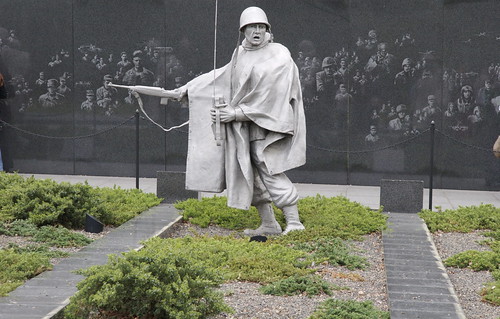
Korean War Memorial

Image by StarrGazr

From 1950 to 1953, the United States joined with the United Nations forces in Korea to take a stand against what was deemed a threat to democratic nations worldwide. At war’s finish, a million and a half American veterans returned to a peacetime globe of families, residences, and jobs – and to a nation long reluctant to view the Korean War as some thing to memorialize. But to the men and women who served, the Korean War could in no way be a forgotten war.

The passing of much more than four decades has brought a new viewpoint to the war and its aftermath. The time has come, in the eyes of the Nation, to set aside a location of remembrance for the men and women who served in this tough-fought war half a planet away. The Korean War Veterans Memorial honors these Americans who answered the call, these who worked and fought under the most attempting circumstances, and those who gave their lives for the trigger of freedom.


A War Half a World Away


Only 5 years had passed given that the finish of Planet War II when the United States after once more found itself embroiled in a key international conflict. In the early morning hours of June 25, 1950, the communist government of North Korea launched an attack into South Korea. Determined to assistance the world’s imperiled democracies, the United States quickly sent troops from Japan to join those currently stationed in Korea they fought with other nations below the U.N. flag. What was envisioned as a brief, decisive campaign became a prolonged, bitter, frustrating fight that threatened to explode beyond Korean borders. For 3 years the fighting raged. In 1953 an uneasy peace returned by signifies of a negotiated settlement that established a new boundary close to the original a single at the 38th parallel.

A single-and-a-half million American guys and ladies, a true cross-section of the Nation’s populace, struggled side by side in the course of the conflict. They served as soldiers, chaplains, nurses, clerks, and in a host of other combat and help roles. Many risked their lives in extraordinary acts of heroism. Of these, 131 received the Congressional Medal of Honor, the Nation’s most esteemed tribute for combat bravery.


A Spot for Reflection


Viewed from above, the memorial is a circle interesected by a triangle. Guests approaching the memorial come initial to the triangular Field of Service. Right here, a group of 19 stainless-steel statues, produced by Planet War II veteran Frank Gaylord, depicts a squad on patrol and evokes the encounter of American ground troops in Korea. Strips of granite and scrubby juniper bushes recommend the rugged Korean terrain, whilst windblown ponchos recall the harsh weather. This symbolic patrol brings with each other members of the U.S. Air Force, Army, Marines, and Navy the guys portrayed are from a range of ethnic backgrounds.

A granite curb on the north side of the statues lists the 22 nations of the United Nations that sent troops or gave medical assistance in defense of South Korea. On the south side is a black granite wall. Its polished surface mirrors the statues, intermingling the reflected photos with the faces etched into the granite. The etched mural is based on actual photographs of unidentified American soldiers, sailors, airmen, and marines. The faces represent all these who provided assistance for the ground troops. With each other these pictures reflect the determination of U.S. forces and the countless methods in which Americans answered their country’s call to duty.


The adjacent Pool of Remembrance, encircled by a grove of trees, provides a quiet setting. Numbers of those killed, wounded, missing in action, and held prisoner-of-war are etched in stone nearby. Opposite this counting of the war’s toll another granite wall bears a message inlaid in silver:

Freedom Is Not Free of charge.


Establishment and Dedication


On October 28, 1986, Congress authorized the American Battle Monuments Commission to establish a memorial in Washington, D.C., to honor members of the U.S. armed forces who served in the Korean War. The Korean War Veterans Memorial Advisory Board was appointed by President Ronald Reagan to advise a web site and design, and to raise building funds. Ground was broken in November 1993. Frank Gaylord was selected as the principal sculptor of the statues and Louis Nelson was selected to create the mural of etched faces on the wall. On July 27, 1995, the 42nd anniversary of the armistice that ended the Korean War, the memorial was devoted by President William J. Clinton and Kim Young Sam, President of the Republic of Korea.


Visiting the Memorial


The memorial is staffed from eight a.m. to midnight each and every day of the year except December 25 by park rangers who are available to answer concerns and give talks. A bookstore in the nearby Lincoln Memorial sells informational items relating to each the memorial and the Korean War.

The Korean War Veterans Memorial is element of the National Park Program, 1 of far more than 370 parks representing our nation’s natural and cultural heritage. Address inqueries to: Superintendent, National Capital Parks-Central, 900 Ohio Drive, SW, Washington, DC 20024-2000.

Monday, October 5, 2015

Nice Edm Grinding images

Some cool edm grinding pictures:


When In Rome

Image by danielle_blue

a Symbiotic Party at Ground Zero


When In Rome

Image by danielle_blue

a Symbiotic Party at Ground Zero

Saturday, September 26, 2015

Nice Edm Wire photos

A handful of nice edm wire photos I discovered:


bdm 2007-09-09 edm blo Spain Barcelona Sagrada Familia elo bad ead bth telephone wires eth CRW_5326

Image by rachelgreenbelt

Saturday, September 12, 2015

Nice Edm Grinding images

Check out these edm grinding photos:


When In Rome

Image by danielle_blue

a Symbiotic Celebration at Ground Zero

Sunday, September 6, 2015

Nice Cnc Wire Cutting photos

Check out these cnc wire cutting images:


Minimal Stool

Image by ArandaLasch

PROJECT:

Contemporary Primitive Inventory


PHOTO CREDIT:

ArandaLasch


ArandaLasch

Minimal Stool

Dimensions: 2′-six&quotL x 2′-6&quot H x 2′-six&quot D

Year: 2010

Materials: CNC Wire-reduce EPS Foam, Linex Finish

Commissioned by Fendi at Style Miami 2010


www.arandalasch.com
www.instagram.com/arandalasch


Star Stool

Image by ArandaLasch

PROJECT:

Contemporary Primitive Inventory


PHOTO CREDIT:

ArandaLasch


ArandaLasch

Star Stool

Dimensions: 1′-&quotL x 1′-6&quot H x 1′-six&quot D

Year: 2010

Components: CNC Wire-reduce EPS Foam, Linex Finish

Commissioned by Fendi at Style Miami 2010


www.arandalasch.com
www.instagram.com/arandalasch


Child Stool

Image by ArandaLasch

PROJECT:

Modern day Primitive Inventory


PHOTO CREDIT:

ArandaLasch


ArandaLasch

Infant Stool

Dimensions: 1′-&quotL x 1′-&quot H x 1′-6&quot D

Year: 2010

Materials: CNC Wire-cut EPS Foam, Linex Finish

Commissioned by Fendi at Design Miami 2010


www.arandalasch.com
www.instagram.com/arandalasch

Sunday, August 30, 2015

Nice Machining Manufacturer photos

Check out these machining manufacturer photos:


Image from web page 17 of “Scientific American Volume 85 Quantity 01 (July 1901)” (1901)


Image by World wide web Archive Book Images
Identifier: scientific-american-1901-07-06
Title: Scientific American Volume 85 Number 01 (July 1901)
Year: 1901 (1900s)
Authors:
Subjects: gas railroad munn cents steam companies american electric scientific american natural gas sheet metal sewing machine ten cents american supplement extended island soft coal cubic feet bituminous coal
Publisher:


View Book Web page: Book Viewer
About This Book: Catalog Entry
View All Pictures: All Pictures From Book


Click right here to view book online to see this illustration in context in a browseable on the internet version of this book.


Text Appearing Ahead of Image:
S OIL—SMELTER—MINES « DOUGLAS. LACEY&ampCO. ^ ItuiikerN, lir(»kerM, FImuI Ae^nt f Members N. V. Codsoli,luted St.H-k Kxcliaiine aud Los Angeles, ■W) fal. Stoi-k K.xfharifje. *? 68 BROADWAY and 17 NEW ST.. NEW YORK. ^ Divi«UMiiUi»Rying Mining, Oil and four^ Smelter Stocks^, U^ted aud Uu- &ltC^ lifted, Oiii Specialty. four^ Booklets providing our effective strategy for realizing ^ the massive it-ofits of legitimate mining. •i and ^ smelter investments, subscription blanks, complete Zi particulars, and so on., sent cost-free to any intereste* on ^ appltcatfon. ■♦f BUANtTlES-noston, Philadeliihia. Chicago. 4h rieveliind, Cincinnati, St. L«uis, Hartford and * New JIaveiL Conn. Prescott. Ariz.. Lus Angeles. *) Cal., St. .lohn, N. B., Montreal, Toronto, and ^ T.,oTi(loii. Eiigland. HOMER F. LIVERMORE MiGM grade: STEEL. MALLEABLE. GREY IRON,BRONZE, BRASS and ALUMINIUM CASTIWGS Sen.l Samples far Rates, Statiiif, Quantity Required.80 PEARL STREET. – – BOSTON, MASS.


Text Appearing After Image:
Potent, Itesijoiisive, Durable aud Effective. The ReevesVariable Speed Countershaft for securing any speed withoutchange of belt or loss of time. Es-pecially adapted for all types f)f Iron-witrking Machinery, Iron Lathes,IManei-s, Boiing Mills, Shapers. and so on.Cement, Machinery, ExperimentalMncbinery—in fact all kinds of ma-cliinery requiring a modify of s[ieetl.Witb it a lai^e increusc and a bettergrade tiE operate can be i&gtro«uced. ZJT Send for haiiilsomclii iUustrate^icatalogue N. A. free. REEVES PULLEY CO. COLUMBUS. IND., U. S. A. Acetylene Generators ARE Ideal. Over ten,000 Machines Sold. They are endorsed by each and every user. Send for costs. Handsomely illustrated catalogue.District Hepresentativea all overthe world. EAQLE GENERATOR COMPA^Y, 319 N. 4th Street.St. Louis, Mo.


Note About Photos
Please note that these photos are extracted from scanned page pictures that may have been digitally enhanced for readability – coloration and look of these illustrations may not perfectly resemble the original work.


Image from web page 17 of “Scientific American Volume 85 Number 01 (July 1901)” (1901)


Image by Web Archive Book Photos
Identifier: scientific-american-1901-07-06
Title: Scientific American Volume 85 Number 01 (July 1901)
Year: 1901 (1900s)
Authors:
Subjects: gas railroad munn cents steam companies american electric scientific american organic gas sheet metal sewing machine ten cents american supplement extended island soft coal cubic feet bituminous coal
Publisher:


View Book Web page: Book Viewer
About This Book: Catalog Entry
View All Images: All Photos From Book


Click right here to view book on the web to see this illustration in context in a browseable on-line version of this book.


Text Appearing Before Image:
The No. 4YOST WRITING MACHINE The distinctive attributes of the Yost Ma-chine, permanent alignment, direct inking,lovely function, strength, simplicity, anddurability are shown in perfection in theNo. 4 Model. YostWritinglYlachineCo. NEW YORK CITY. LONDON, ENQ.


Text Appearing Following Image:
S OIL—SMELTER—MINES « DOUGLAS. LACEY&ampCO. ^ ItuiikerN, lir(»kerM, FImuI Ae^nt f Members N. V. Codsoli,luted St.H-k Kxcliaiine aud Los Angeles, ■W) fal. Stoi-k K.xfharifje. *? 68 BROADWAY and 17 NEW ST.. NEW YORK. ^ Divi«UMiiUi»Rying Mining, Oil and 4^ Smelter Stocks^, U^ted aud Uu- &ltC^ lifted, Oiii Specialty. 4^ Booklets providing our effective plan for realizing ^ the huge it-ofits of reputable mining. •i and ^ smelter investments, subscription blanks, full Zi particulars, and so forth., sent cost-free to any intereste* on ^ appltcatfon. ■♦f BUANtTlES-noston, Philadeliihia. Chicago. 4h rieveliind, Cincinnati, St. L«uis, Hartford and * New JIaveiL Conn. Prescott. Ariz.. Lus Angeles. *) Cal., St. .lohn, N. B., Montreal, Toronto, and ^ T.,oTi(loii. Eiigland. HOMER F. LIVERMORE MiGM grade: STEEL. MALLEABLE. GREY IRON,BRONZE, BRASS and ALUMINIUM CASTIWGS Sen.l Samples far Prices, Statiiif, Quantity Needed.80 PEARL STREET. – – BOSTON, MASS.


Note About Pictures
Please note that these pictures are extracted from scanned page photos that may have been digitally enhanced for readability – coloration and look of these illustrations might not perfectly resemble the original perform.


Image from web page 17 of “Scientific American Volume 85 Quantity 01 (July 1901)” (1901)


Image by Web Archive Book Photos
Identifier: scientific-american-1901-07-06
Title: Scientific American Volume 85 Number 01 (July 1901)
Year: 1901 (1900s)
Authors:
Subjects: gas railroad munn cents steam companies american electric scientific american all-natural gas sheet metal sewing machine ten cents american supplement long island soft coal cubic feet bituminous coal
Publisher:


View Book Web page: Book Viewer
About This Book: Catalog Entry
View All Images: All Pictures From Book


Click right here to view book online to see this illustration in context in a browseable on the web version of this book.


Text Appearing Before Image:
LESGHEN &amp SONS ROPE Owners and ManufacturersLESCHEN CO.S PATENT AUTOMATIC AERIAL


Text Appearing Following Image:
(Ira-ie Mark littgistered.) WIRE ROPE TRAMWAY -^^^o?JrT^og.cWIRE ROPE We also manufacture all types of « KODAK 99 Stands for allthat is Very best inPhotography To the perfection of Kodakconstruction, to the perfec=tion of the Kodak mechan=ism, to the perfection ofthe Kodak lenses, is due the triumph of Kodakerp All Kodaks I^oail in Daylight with our TransparentFilm Cartriilfjes. A number of designs use either films •rplates. Sixty-4 page cataiofjiie, tiescribiiig themin detail, free at the Kodak dealers or by mail. EASTMAN KODAK CO. Rochester, N. Y. .jFSSOPS STEEL^BV/r J^ FOR TOOLS. SAWS And so on. WM JESSOP A SONS L5 91 JOHN ST. NEW YORK PETER T. AUSTEN CHEMICAL Expert. Testing, Ierfei-ting, Introducing and Disposing ofChemical Patents, Processes. Il-oducts, horinulas. and so forth. Utilization of Wastes and Unapjjlied Subsiances. Im-provement and Invention of Processes ami Iniducts.Reduction of Manufacturing Costs. E.^perinieiital In-vestieation of rocluiical Issues. Workitig out hor-mulas tor Manu


Note About Images
Please note that these photos are extracted from scanned web page pictures that may have been digitally enhanced for readability – coloration and look of these illustrations may not completely resemble the original operate.

Saturday, August 22, 2015

Nice Cnc Milling Turning images

A couple of nice cnc milling turning pictures I identified:


MC68HC908GP32 motor controller


Image by Mitchclanky2008

The 1st pcb i created and contribuited to the develop of – hand soldered vias! This was produced on a CNC milling machine rather than being acid etched as JCU does not have the facilities. It worked with some minor modifications (a track cut and a capacitor soldered directly to the cut track). The green LED shown was attached to a programmable output of the micro, which is why its not on in this photo. Hooked into a board (which i dont have a photo of) which had two pots, one of which was controlled by a motor – the aim being to handle the motor to match the pots to any turned worth.


Take my Lightning but Do not Steal my Thunder – Covent Garden


Image by Dave Pearce (London)

This surreal stunt is the operate of 30-year-old artist Alex Chinneck, master of architectural illusion, who has previously turned buildings upside down, pulled off their facades, and let them slither down in a heap on the pavement. A Uri Geller of bricks and mortar, this is 1 of his most ambitious works but, fabricating an imaginary eastern entrance to the industry hall that he’s then torn in half and jacked aloft, its Portland stone columns and granite walls left brutally severed.


“I wanted to play on the theatricality of this location, and make anything physically extraordinary,” he says. In location for the subsequent 3 weeks, it is already attracting crowds of gawping passers-by, as a visually arresting a single-liner, seemingly produced for the Instagram era.


The illusion of weightlessness is created achievable by a lot of polystyrene and 16 tonnes of steel. A 12-metre armature hidden inside the structure is connected to the ground by way of an innocuous market cart, in which a six-tonne counterweight stops it all from toppling more than. The effect of weathered stonework has been immaculately recreated by Richard Nutbourne and his group of scenic artists – who usually function on stage sets for the opera and ballet subsequent door. Covering the CNC-milled polystyrene blocks with plaster and granite sand, they have mimicked the neighbouring gnarled stone even down to the detail of moss, electrostatically flocked onto the surface.


“My perform is generally quite easy in its idea,” says Chinneck, “but it is a nightmare in execution.” Eight months in the producing, the Covent Garden installation is the product of a 100-strong team of architects and engineers, carpenters and set-builders, and much more than 500 hours of digital carving. It follows preceding commissions in the piazza from Jeff Koons and Damien Hirst, Banksy and Sam Taylor-Johnson.

Friday, August 7, 2015

Nice Cnc Turning photos

Check out these cnc turning images:


WSC2013_skill06_mi_024


Image by WorldSkills


WSC2013_skill06_mi_018


Image by WorldSkills


WSC2013_skill06_mi_081


Image by WorldSkills

Thursday, August 6, 2015

Nice Cnc Wire Cutting images

Check out these cnc wire cutting pictures:


Side Table


Image by ArandaLasch

PROJECT:

Modern Primitive Inventory


PHOTO CREDIT:

ArandaLasch


ArandaLasch

Side Table

Dimensions: 1′-six&quotL x 1′-six&quot H x 1′-six&quot D

Year: 2010

Components: CNC Wire-cut EPS Foam, Linex Finish

Commissioned by Fendi at Style Miami 2010


www.arandalasch.com
www.instagram.com/arandalasch

Saturday, July 25, 2015

Nice Vertical Grinding photos

Verify out these vertical grinding images:


Daily life


Image by CIFOR

Kids assisting mill the grain, Africa.


Photo by Daniel Tiveau for Center for International Forestry Investigation (CIFOR).


www.cifor.org


weblog.cifor.org


If you use one particular of our images, please credit it accordingly and let us know. You can reach us by means of our Flickr account or at: cifor-mediainfo@cgiar.org


London City – Operating Out Of Sky (On Discover 23rd Jun 2014) (Thankyou All For More than 2 Million Views) (Original Version)


Image by Simon & His Camera

Much more Canary Wharf workplace buildings. Anybody who follows me knows that I occasionally point out that the a lot more London builds the less sunlight will reach the ground and we will endure from a lot more depression, that S.A.D. problem. Just an notion will not impact me I enjoy buildings………….


Sorry no plane with this one particular…..


This photo is also in honour of my two million views barrier……………


Newer Version Here – www.flickr.com/pictures/simon__syon/16387151163/

—————————————————–

Image Utilized On This Site – abacusllc.net/


Also this one particular – theconversation.com/dont-trust-your-bank-heres-how-it-cou…


Also This One particular – mpworks.jp/post-145/


Also This A single – www.sounds-like-me.com/blogs/travelettes/


Also This 1 – silverwatermg.com/


Also This One – ricardo-saldivar-wl0g.squarespace.com/welcome#lineaccounting

…………………………………………………………..

Thanks for your Views &amp Fave &amp your comments are usually welcome.


Please do not use this image on web sites, blogs or other media without my explicit permission.


This perform by Simon Hadleigh-Sparks is licensed below a Inventive Commons Attribution-NoDerivatives four. International License.

Friday, July 24, 2015

Nice Electrical Discharge Wire Cutting pictures

Some cool electrical discharge wire cutting photos:


Image from web page 158 of “Workout routines in sensible physiology” (1897)


Image by Internet Archive Book Images
Identifier: exercisesinpract00wall
Title: Workout routines in sensible physiology
Year: 1897 (1890s)
Authors: Waller, Augustus Désiré, 1856-1922
Subjects: Physiology Biochemistry
Publisher: London New York, N.Y. Bombay : Longmans, Green, and Co.
Contributing Library: Columbia University Libraries
Digitizing Sponsor: Open Information Commons


View Book Web page: Book Viewer
About This Book: Catalog Entry
View All Pictures: All Pictures From Book


Click right here to view book on-line to see this illustration in context in a browseable on-line version of this book.


Text Appearing Before Image:
Fig. 27. and zinc of a Daniell cell, and discharged when connected bya sufficient conductor. Either the charge or the dischargemay be produced by way of a nerve. Connect the middle pair of pools of a commutator withoutcross wires to the terminals of a condenser, connect thetwo lateral pairs with a cell and with the nerve of a nerve-muscle preparation as m fig. 27. With the cradle of the commutator as shown in thediagram, the condenser is connected with the cell andcharged. When the cradle is turned more than, the chargedcondenser is disconnected from the cell and connected withthe nerve via which it is discharged, provoking asingle twitch of the attached muscle. IN THE PHYSIOLOGY OF THE NERVOUS Method. 29 Minimum energy of stimulus. Dem. With stimulation by the discharge (or charge) of a con-denser we can express in terms of power the worth of theelectrical stimulus. JV^0T3P. kcv


Text Appearing Right after Image:
Fig. 28. Charge from + by means of b ce ejp pto — when get in touch with is produced at 6 by depres-sing the Morse essential (and broken at a) viz., ascending in the nerve. Discharge from p through e ec a to p when make contact with is produced at a by recoil ofthe Morse crucial (and broken at b) viz., descending in the nerve. The bridging crucial is for the purpose of cutting out from the nerve either thecharge or the discharge. If desired this could be effected with out the bridgingkey by the circuits 1 and two of fig. 29, substituting the thrilling electrodes e e forthe galvonometer SN. Put up connections in accordance with fig. 28, employing acondenser of 010 microfarad, subdivided into components = 001. Figure out by adjustment of the rheostats r, E, the smallestfraction of a volt that will excite the nerve of a nerve-musclepreparation : — (A) with the condenser at OlO microfarad (B) with the condenser at *01 microfarad and calculate in the two instances the quantity and the energy ofsuch a minimal electrical stimulus. (C) with a conveni


Note About Photos
Please note that these images are extracted from scanned page photos that could have been digitally enhanced for readability – coloration and appearance of these illustrations may not completely resemble the original function.


Image from web page 847 of “Modern day mechanism, exhibiting the latest progress in machines, motors, and the transmission of energy, being a supplementary volume to Appletons’ cyclopaedia of applied mechanics” (1892)


Image by Net Archive Book Pictures
Identifier: modernmechanisme00benj
Title: Modern day mechanism, exhibiting the most recent progress in machines, motors, and the transmission of energy, getting a supplementary volume to Appletons’ cyclopaedia of applied mechanics
Year: 1892 (1890s)
Authors: Benjamin, Park, 1849-1922
Subjects: Mechanical engineering
Publisher: New York, D. Appleton
Contributing Library: Mugar Memorial Library, Boston University
Digitizing Sponsor: Boston University


View Book Web page: Book Viewer
About This Book: Catalog Entry
View All Photos: All Photos From Book


Click right here to view book online to see this illustration in context in a browseable on the web version of this book.


Text Appearing Ahead of Image:
d stroke, it is apparent that if the feed wheel is run down against it in the positionshown in the engraving, the pusher will be provided its full traverse and the greatest feed. Ifrun back to clear the travel of the agitator, the pusher will, of course, have no motion and thefeed will stop. Amongst these extremes any preferred rate of feed can be offered. In like manner, the rock of the grate bars can be adjusted amongst any limiting angles,and over a variety of motion from no movement to complete throw, by means of the sheath nut andjam nuts on the connecting rod. By these adjustments the whole action of the stoker iscontrolled, and the fires forced, checked, or banked at will. Stone Breaker : see Ore-crushing Machines. ST0R.4.(tE batteries. The storage, secondary or reversible battery, and accumu-lator are diverse terms applied to a kind of cell primarily based on the principle demonstrated byFaraday in 1834, that chemical and electrical energy had been mutually convertible. In 1859, 816 STORAGE BATTERIES.


Text Appearing Right after Image:
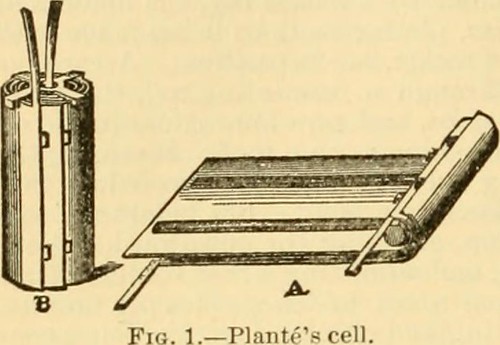
after experiments with a variety of metals, Plante decided upon the use of lead plates in dilutesulphuric acid, since in discharge each plates have been active that is, not only did the per-oxide of lead plate combine witli hydrogen, but the lowered metallic lead combined withoxygen. Plauies cell was initially constructed with two plates of sheet lead, separated bygutta-percha strips, one sheet bcinglaid more than the other, with two gutta-percha strips betweenthem, and two far more laid on the upper sheet, as shown at A, Fig. 1. They were then rolled with each other and clamped, as shown at B, a strip of leail becoming left attached to the corner of each sheet in cutting, bywhich connection could i)e made. The sheets thusrolled togetlier had been ])hiced in a jar of glass or ebonite,containing a ten per cent, remedy of sulphuric acid.The jar had an ebonite cover, with binding screws towhich the connecting strips had been attached alsoclamps for holding wires to show the heating effectof the discharge. The electr


Note About Pictures
Please note that these images are extracted from scanned page images that might have been digitally enhanced for readability – coloration and look of these illustrations may possibly not completely resemble the original work.

Monday, July 6, 2015

Nice Manufacturer Of Precision Machined Components pictures

Check out these manufacturer of precision machined components photos:


Steven F. Udvar-Hazy Center: B-29 Superfortress “Enola Gay”


Image by Chris Devers

Quoting Smithsonian National Air and Space Museum | Boeing B-29 Superfortress &quotEnola Gay&quot:


Boeing’s B-29 Superfortress was the most sophisticated propeller-driven bomber of Globe War II and the first bomber to residence its crew in pressurized compartments. Despite the fact that developed to fight in the European theater, the B-29 located its niche on the other side of the globe. In the Pacific, B-29s delivered a assortment of aerial weapons: standard bombs, incendiary bombs, mines, and two nuclear weapons.


On August 6, 1945, this Martin-constructed B-29-45-MO dropped the 1st atomic weapon utilised in combat on Hiroshima, Japan. Three days later, Bockscar (on show at the U.S. Air Force Museum close to Dayton, Ohio) dropped a second atomic bomb on Nagasaki, Japan. Enola Gay flew as the advance weather reconnaissance aircraft that day. A third B-29, The Great Artiste, flew as an observation aircraft on each missions.


Transferred from the United States Air Force.


Manufacturer:
Boeing Aircraft Co.
Martin Co., Omaha, Nebr.


Date:

1945


Nation of Origin:

United States of America


Dimensions:

All round: 900 x 3020cm, 32580kg, 4300cm (29ft 6 five/16in. x 99ft 1in., 71825.9lb., 141ft 15/16in.)


Components:

Polished general aluminum finish


Physical Description:

Four-engine heavy bomber with semi-monoqoque fuselage and higher-aspect ratio wings. Polished aluminum finish general, standard late-Planet War II Army Air Forces insignia on wings and aft fuselage and serial quantity on vertical fin 509th Composite Group markings painted in black &quotEnola Gay&quot in black, block letters on lower left nose.


Steven F. Udvar-Hazy Center: South hangar panorama, like Vought OS2U-3 Kingfisher seaplane, B-29 Enola Gay


Image by Chris Devers

Quoting Smithsonian National Air and Space Museum | Vought OS2U-3 Kingfisher:


The Kingfisher was the U.S. Navy’s main ship-based, scout and observation aircraft throughout Planet War II. Revolutionary spot welding strategies gave it a smooth, non-buckling fuselage structure. Deflector plate flaps that hung from the wing’s trailing edge and spoiler-augmented ailerons functioned like added flaps to permit slower landing speeds. Most OS2Us operated in the Pacific, exactly where they rescued a lot of downed airmen, which includes World War I ace Eddie Rickenbacker and the crew of his B-17 Flying Fortress.


In March 1942, this airplane was assigned to the battleship USS Indiana. It later underwent a six-month overhaul in California, returned to Pearl Harbor, and rejoined the Indiana in March 1944. Lt. j.g. Rollin M. Batten Jr. was awarded the Navy Cross for generating a daring rescue in this airplane under heavy enemy fire on July 4, 1944.


Transferred from the United States Navy.


Manufacturer:
Vought-Sikorsky Aircraft Division


Date:

1937


Country of Origin:

United States of America


Dimensions:

General: 15ft 1 1/8in. x 33ft 9 1/2in., 4122.6lb., 36ft 1 1/16in. (460 x 1030cm, 1870kg, 1100cm)


Supplies:

Wings covered with fabric aft of the primary spar


Physical Description:

Two-seat monoplane, deflector plate flaps hung from the trailing edge of the wing, ailerons drooped at low airspeeds to function like added flaps, spoilers.


• • • • •


Quoting Smithsonian National Air and Space Museum | Boeing B-29 Superfortress &quotEnola Gay&quot:


Boeing’s B-29 Superfortress was the most sophisticated propeller-driven bomber of Planet War II and the first bomber to residence its crew in pressurized compartments. Though designed to fight in the European theater, the B-29 located its niche on the other side of the globe. In the Pacific, B-29s delivered a variety of aerial weapons: standard bombs, incendiary bombs, mines, and two nuclear weapons.


On August six, 1945, this Martin-built B-29-45-MO dropped the very first atomic weapon employed in combat on Hiroshima, Japan. 3 days later, Bockscar (on show at the U.S. Air Force Museum close to Dayton, Ohio) dropped a second atomic bomb on Nagasaki, Japan. Enola Gay flew as the advance weather reconnaissance aircraft that day. A third B-29, The Excellent Artiste, flew as an observation aircraft on both missions.


Transferred from the United States Air Force.


Manufacturer:
Boeing Aircraft Co.
Martin Co., Omaha, Nebr.


Date:

1945


Nation of Origin:

United States of America


Dimensions:

Overall: 900 x 3020cm, 32580kg, 4300cm (29ft 6 5/16in. x 99ft 1in., 71825.9lb., 141ft 15/16in.)


Materials:

Polished all round aluminum finish


Physical Description:

4-engine heavy bomber with semi-monoqoque fuselage and high-aspect ratio wings. Polished aluminum finish overall, standard late-World War II Army Air Forces insignia on wings and aft fuselage and serial number on vertical fin 509th Composite Group markings painted in black &quotEnola Gay&quot in black, block letters on reduce left nose.

Sunday, July 5, 2015

Nice Gear Grinding photographs

Some cool gear grinding images:


Gears


Image by p.rueger

rusty metal gears on the ground


Gears


Image by BinaryApe

Gearing on a rusting old machine we noticed in the yard of a church in Castleton. My guess is that it was for grinding lead ore. It was manufactured in Manchester.


Gears Grind Slow


Image by swanksalot

on the boat

Friday, July 3, 2015

Wednesday, October 15, 2014

Nice Turning Cnc images

Check out these turning cnc photos:


WorldSkills2013 “CNC Turning”


Image by 1step.to


WorldSkills2013 “CNC Turning”


Image by 1step.to


(Posted by an precision machining China Company and quality CNC machined parts China manufacturer and CNC machining services China supplier)

Tuesday, October 14, 2014

Nice Prototype Manufacturing Organization pictures

Some cool prototype manufacturing company photos:


Endurance


Image by . SantiMB .

This is a specimen of Montesa Impala (legendary spanish motorbike) that I have discovered in the garage exactly where I hold the automobile. It is in ideal state in spite of its antiquity, and that demonstrates that it perfectly fulfills the objective of his existence: endurance.


I dedicate this photo to a operate mate that, even though she is not registered in Flickr, she visits my photos frequently, and for days it has been releasing new moto.


I have taken many images, with diverse angles, with and without having flash, HDR, Orton… and ultimately I select this one particular without having flash, that she is the a single that better represents what is this machine. Following see it time and once again, I have decided to do a cutout with partial desaturation for eliminate the colours of the wall and the floor, and leave only the red and yellow colours of the bike.


Montesa Honda is now the Spanish subsidiary of Honda, which assembles numerous models of motorcycles, bicycles, and components at its Barcelona plant. The firm exports 75 per cent of its production to the rest of Europe.


Formed in 1944 by Pedro Permanyer and Francisco Xavier Bultó, the first Montesa prototype was constructed primarily based upon the French Motobécane models of that time. Powered by a 93cc two-stroke engine with no rear suspension 22 of these units had been sold in the very first year and so promising did the market place seem that Permanyer and Bulto formulated their partnership. As a successor to the preceding model, Senor Bulto made a new 125cc roadster, which was tested in numerous trail variety rallies and semi-enduros that were well-liked in Spain at the time.


In 1961 Leopoldo Milá was working intensively on the &quotImpala&quot project. 1 of the fundamentals of the project was to assure the top quality and reliability of the product, and that is why it was required to topic the prototypes to tough, exhaustive testing.


Along the way the thought arose to make a motorcycle crossing of Africa, from north to south, where the most attempting conditions have been insured. The strategy was risky and ambitious. Five volunteers speedily appeared to make the trip: Oriol Regás, Tey Elizalde, Enrique Vernis, Rafael Marsans and Manuel Maristany.


Crossing Africa by motorcycle, from Capetown to Cairo, beneath the circumstances of the time, was an adventure of epic proportions. The media covered the event really closely.

3 &quotImpala&quot prototypes had been painstakingly ready, and, in the firm of a back up Land-Rover, the adventure kicked off on 15 January 1962. For the duration of 1000 days, and crossing 20,000 kilometres, no higher troubles arose than a couple of minor incidents that cropped up along the way in inhospitable nations, through forests and plains, with out roads and facing a myriad of risks of all types.


The style tips of Leopoldo Milá had been confirmed and the final project was a complete good results. The new Montesa &quotImpala&quot earned from the very first moment onward main technical, industrial and sports accomplishment. An instance for design and style was also set which has not been invalidated with the passing of time.


You can nonetheless see &quotImpalas&quot being driven on the streets of Barcelona, which is some thing entirely unusual provided that they had been created in 1961. Young motorcycle drivers still nowadays compete with each other for the acquire of these models as if they were precious jewels. The Montesa &quotimpala&quot was awarded the ADI-FAD prize for the very best industrial style in 1962. At that time the business had 460 personnel on the payroll, and production of 11,000 units per year.


The reigning industrial notion of the time was that of hugely integrated manufacturing: foundry perform, presses, welding, full mechanisation of the engine, painting, and assembly …The models manufactured simultaneously in the sixties were the &quotImpala&quot, the &quotImpala Sport&quot, &quotComando&quot, and production for the initial time was begun for the assembly line production of a Moto-Cross bike (the &quotImpala Cross&quot 175 and 250-cc.), essentially for export. A new model primarily based on a very sophisticated notion for the time was also launched: the 4-speed 60-cc scooter named the Montesa &quotMicroscooter&quot.


Sources: en.wikipedia.org/wiki/Montesa_Honda and www.montesaweb.com/ang/frame_unionhistoria.htm.


Alvis Speed 25


Image by pedrosimoes7

MotorClássicos,Lisbon, Portugal


Belem, Lisbon, Portugal


in Wikipedia


Alvis cars have been created by the manufacturer Alvis Auto and Engineering Business Ltd of Coventry, United Kingdom from 1919 to 1967. The business also made aero-engines and military autos, the latter continuing long soon after auto production ceased.


Beginnings


The original firm, TG John and Co. Ltd., was founded in 1919. Its 1st items had been stationary engines, carburettor bodies and motorscooters. The company’s founder T.G. John was approached by Geoffrey de Freville with styles for a four-cylinder engine with aluminium pistons and pressure lubrication, unusual for the period. Some have recommended that de Freville proposed the name Alvis as a compound of the words &quotaluminium&quot and &quotvis&quot (meaning &quotstrength&quot in Latin) although de Freville himself vigorously denied this theory. Probably the name was derived from the Norse mythological weaponsmith, Alvíss, but the accurate origin is unknown.


The initial automobile model, the 10/30, making use of de Freville’s style was an immediate accomplishment and set the reputation for top quality and efficiency for which the firm became famous. Following complaints from the Avro aviation company whose logo bore similarities to the original winged green triangle, the far more familiar inverted red triangle incorporating the word ‘Alvis’ evolved. In 1921, the firm changed its name and became the Alvis Car and Engineering Company Ltd. and moved production to Holyhead Road, Coventry where from 1922 to 1923 they also created the Buckingham vehicle.


In 1923 Captain GT Smith-Clarke joined from Daimler as Chief Engineer and Works Manager and was quickly joined by WM Dunn as Chief Draughtsman. This partnership lasted for 25 years and was accountable for generating some of the most effective merchandise in the company’s history.

The original 10/30 side-valve engine was created progressively becoming by 1923 the popular overhead-valve 12/50, produced until 1932 and one particular of the most effective vintage sports automobiles of all time. Exhilarating efficiency and rugged reliability meant that about 350 of these 12/50 hp automobiles and 60 of the later (and latterly concurrent) 12/60 hp survive today representing some 10 percent of total production.


1927 saw the introduction of the six-cylinder 14.75 h.p. and this engine became the basis for the long line of luxurious six-cylinder Alvis cars made up to the outbreak of war. Not only have been these cars really sophisticated but they were full of technical innovations. Independent front suspension and the world’s 1st all-synchromesh gearbox came in 1933 followed by servo assisted brakes. A front wheel drive model was introduced (from 1928 to 1930), a model bristling with innovation with front wheel drive, in-board brakes, overhead camshaft and, as an choice, a Roots variety supercharger.


Smith-Clarke developed remarkable models for the duration of the 1930s and 1940s — which includes the handsome, low-slung six-cylinder Speed 20, the Speed 25 (considered by many to be one of the finest vehicles produced in the 1930s) and the 4.3 Litre model. As with several upmarket engineering companies of the time Alvis did not produce their personal coachwork relying alternatively on the many obtainable Midlands coachbuilders such as Cross and Ellis, Charlesworth and Vanden Plas. Several vehicles also survive with really exotic one particular-off bodywork from other designers. In 1936, the company name was changed to Alvis Ltd and by the beginning of the war, aero-engine and armoured automobile divisions had been added to the organization.


Planet War Two


In September 1939 following the outbreak of war vehicle production was suspended, but was later allowed to resume and production of the 12/70, Silver Crest, Speed 25, and 4.three Litre continued properly into 1940. Throughout Planet War II the auto factory was severely damaged in the German Luftwaffe raid on Coventry in 1940 though strangely the armaments factory emerged fairly unscathed. Much valuable gear cutting and other equipment was lost and car production was suspended for the duration of the war only resuming for the duration of the latter part of 1946. Despite this, Alvis carried out war production on aero engines (as sub-contractor of Rolls-Royce) and other aeroplane gear.


Post war


Automobile production resumed with a 4-cylinder model, the TA14, based on the pre-war 12/70. A solid, reputable and eye-catching automobile, the TA14 fitted well the mood of sober austerity in post war Britain, but significantly of the magic attaching to the potent and sporting pre-war models had gone and life was not easy for a specialist car manufacturer. Not only had Alvis lost their car factory but several of the prewar coachbuilders had not survived either and these that had have been swiftly acquired by other producers. In reality, the post war history of Alvis is dominated by the quest for reliable and reasonably priced coachwork.


Smith-Clarke himself retired in 1950 and Dunn took more than as chief engineer. In 1950 a new chassis and six-cylinder three litre engine was announced and this highly profitable engine became the basis of all Alvis models till production ceased in 1967. Saloon bodies for the TA21, as the new model was named, again came from Mulliners of Birmingham as they had for the TA14, with Tickford creating the dropheads. But with the first of these becoming part of Normal Triumph and the second becoming acquired by Aston Martin Lagonda, it was clear by 1954 that new arrangements would have to be made. By this time some of the most original and gorgeous styles on the three litre chassis had been becoming produced by master coachbuilder Hermann Graber of Switzerland and indeed these 1-off designed cars are hugely sought soon after today. With a licence in spot, from 1955 all Alvis bodies became based on Graber styles. Early examples, the TC108/G, were built by Willowbrook of Loughborough but at such a higher price tag that very handful of had been created. Only soon after 1958 with the launch of the TD21 did one thing resembling complete scale production resume as Park Ward, coachbuilders for Rolls-Royce and Bentley, contracted to create the bodies at a much decrease value. These automobiles, the TD21 and its later variants, the TE21 and finally the TF21 are well built, attractive and quick cars. Nonetheless it was clear by the mid sixties that with a price tag of almost double that of the mass created Jaguar the end could not be far off.

There had been several ‘might-have-beens.’ From 1952 to 1955 Alec Issigonis, the creator of the later Mini worked for Alvis and created a new model with a V8 engine which proved too high-priced to produce.


Rover took a controlling interest in Alvis in 1965 and a Rover-created mid-engined V8 coupé prototype named the P6BS was rumoured to be the new Alvis model but with the takeover by British Leyland this also was shelved. By the time the TF21 was launched in 1966, (obtainable, like its predecessors in each saloon and drophead kind and with either manual or automatic gearbox), the model was beginning to show its age despite a top speed of 127 mph – the fastest Alvis ever produced. With only 109 sold and with political troubles aplenty in the UK automobile manufacturing company at that time, production lastly ceased in 1967. In 1968, a management buyout was finalised and all the Alvis design plans, buyer records, stock of components and remaining staff have been transferred to Red Triangle. The Alvis name lived on with armoured fighting automobile production.


Modern


Primary article: Alvis plc


As portion of Rover, Alvis Restricted was incorporated into British Leyland but was purchased by United Scientific Holdings plc in 1981. Subsequently the company’s name changed to Alvis plc. In 1998, the armoured automobile enterprise of GKN plc was taken on and the primary UK manufacturing operation moved from Coventry to Telford. The website of the Alvis operates in Holyhead Road is now an out-of-town buying complex, but its name, Alvis Retail Park, reflects the heritage of the web site.

In 2002 Alvis group purchased Vickers to type the subsidiary Alvis Vickers Ltd which was subsequently bought by BAE Systems in 2004. BAE Systems ended the use of the Alvis distinctive ‘red triangle’ trademark.

In 2009, Red Triangle negotiated the legal transfer of the Alvis vehicle trademarks and in 2010 announced the very desirable 4.3-Litre Short Chassis tourer would as soon as again be accessible. All Alvis’ records stay intact at the company’s Kenilworth headquarters along with a huge stock of period parts. Amazingly, one of the guys to have worked on the extremely final Alvis auto created in 1967 is still retained by the firm in a education capacity.


Constructed to the original plans, the new vehicle has been named the ‘Continuation Series’ to reflect the 73-year interruption in its production between 1937 and 2010. It differs only in detail from the pre-war examples: for emissions, the engine is governed by an Electronic Fuel Injection program with electric ignition, brakes are hydraulic rather than cable, the steering column collapsible and the rear light arrangement reconfigured to conform to modern requirements.


(Posted by an precision machining China Company and quality CNC machined parts China manufacturer and CNC machining services China supplier)

Monday, October 13, 2014

Nice Turning Components Manufacturer photographs

Some cool turning parts manufacturer pictures:


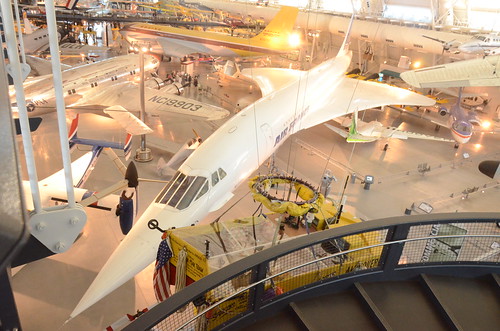
Steven F. Udvar-Hazy Center: Air France Concorde


Image by Chris Devers

Quoting Smithsonian National Air and Space Museum | Concorde, Fox Alpha, Air France:


The first supersonic airliner to enter service, the Concorde flew thousands of passengers across the Atlantic at twice the speed of sound for more than 25 years. Designed and constructed by Aérospatiale of France and the British Aviation Corporation, the graceful Concorde was a beautiful technological achievement that could not overcome severe economic issues.


In 1976 Air France and British Airways jointly inaugurated Concorde service to destinations about the globe. Carrying up to one hundred passengers in fantastic comfort, the Concorde catered to initial class passengers for whom speed was vital. It could cross the Atlantic in fewer than four hours – half the time of a conventional jet airliner. Nevertheless its high operating expenses resulted in very higher fares that restricted the quantity of passengers who could afford to fly it. These problems and a shrinking industry eventually forced the reduction of service till all Concordes were retired in 2003.


In 1989, Air France signed a letter of agreement to donate a Concorde to the National Air and Space Museum upon the aircraft’s retirement. On June 12, 2003, Air France honored that agreement, donating Concorde F-BVFA to the Museum upon the completion of its last flight. This aircraft was the 1st Air France Concorde to open service to Rio de Janeiro, Washington, D.C., and New York and had flown 17,824 hours.


Gift of Air France.


Manufacturer:
Societe Nationale Industrielle Aerospatiale
British Aircraft Corporation


Dimensions:

Wingspan: 25.56 m (83 ft 10 in)

Length: 61.66 m (202 ft three in)

Height: 11.3 m (37 ft 1 in)

Weight, empty: 79,265 kg (174,750 lb)

Weight, gross: 181,435 kg (400,000 lb)

Leading speed: two,179 km/h (1350 mph)

Engine: Four Rolls-Royce/SNECMA Olympus 593 Mk 602, 17,259 kg (38,050 lb) thrust every single

Manufacturer: Société Nationale Industrielle Aérospatiale, Paris, France, and British Aircraft Corporation, London, United Kingdom


Physical Description:

Aircaft Serial Number: 205. Such as 4 (four) engines, bearing respectively the serial quantity: CBE066, CBE062, CBE086 and CBE085.

Also included, aircraft plaque: &quotAIR FRANCE Lorsque viendra le jour d’exposer Concorde dans un musee, la Smithsonian Institution a dores et deja choisi, pour le Musee de l’Air et de l’Espace de Washington, un appariel portant le couleurs d’Air France.&quot


(Posted by an precision machining China Company and quality CNC machined parts China manufacturer and CNC machining services China supplier)