A few nice prototype manufacturing company images I found:
Riley Brooklands 1930
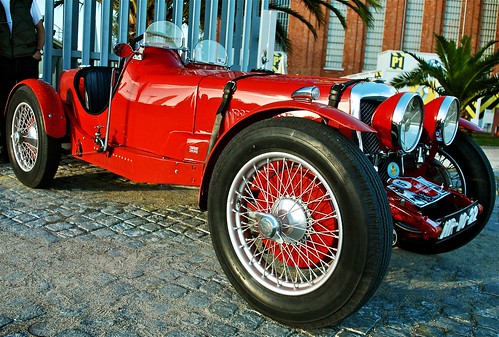
Image by pedrosimoes7
Belem, Lisbon, Portugal
in Wikipedia
Riley was a British motorcar and bicycle manufacturer from 1890. The company became part of the Nuffield Organisation in 1938 and was later merged into British Leyland: late in 1969 British Leyland announced their discontinuance of Riley production, although 1969 was a difficult year for the UK auto industry and so a number of cars from the company’s inventory are likely to have been first registered only in 1970.[2]
Today, the Riley trademark is owned by BMW.
Riley Cycle Company
Riley began as the Bonnick Cycle Company of Coventry, England. During the pedal cycle craze that swept Britain at the end of the nineteenth century, in 1890, William Riley Jr. purchased the company and in 1896 renamed it the Riley Cycle Company.[2] Later, cycle gear maker Sturmey Archer was added to the portfolio. Riley’s younger son, Percy, left school in the same year and soon began to dabble in automobiles. He built his first car at 16, in 1898, secretly, because his father did not approve. It featured the first mechanically operated inlet valve. By 1899, Percy Riley moved from producing motorcycles to his first prototype four-wheeled quadricycle. Little is known about Percy Riley’s very first "motor-car". It is, however, well attested that the engine featured mechanically operated cylinder valves at a time when other engines depended on the vacuum effect of the descending piston to suck the inlet valve(s) open. That was demonstrated some years later when Benz developed and patented a mechanically operated inlet valve process of their own but were unable to collect royalties on their system from British companies; the courts were persuaded that the system used by British auto-makers was based the one pioneered by Percy, which had comfortably anticipated equivalent developments in Germany.[2] In 1900, Riley sold a single three-wheeled automobile. Meanwhile the elder of the Riley brothers, Victor Riley, although supportive of his brother’s embryonic motor-car enterprise, devoted his energies at this stage to the core bicycle business.[2]
Company founder William Riley remained resolutely opposed to diverting the resources of his bicycle business into motor cars, and in 1902 three of his sons, Victor, Percy and younger brother Alan Riley pooled resources, borrowed a necessary balancing amount from their mother and in 1903 established the separate Riley Engine Company, also in Coventry.[2] A few years later the other two Riley brothers, Stanley and Cecil, having left school joined their elder brothers in the business.[2] At first, the Riley Engine Company simply supplied engines for Riley motorcycles and also to Singer, a newly emerging motor cycle manufacturer in the area,[2] but the Riley Engine Company company soon began to focus on four-wheeled automobiles. Their Vee-Twin Tourer prototype, produced in 1905, can be considered the first proper Riley car. The Engine Company expanded the next year. William Riley reversed his former opposition to his sons’ preference for motorised vehicles and Riley Cycle halted motorcycle production in 1907 to focus on automobiles.[2] Bicycle production also ceased in 1911.
In 1912, the Riley Cycle Company changed its name to Riley (Coventry) Limited as William Riley focused it on becoming a wire-spoked wheel supplier for the burgeoning motor industry, the detachable wheel having been invented (and patented) by Percy and distributed to over 180 motor manufacturers, and by 1912 the father’s business had also dropped automobile manufacture in order to concentrate capacity and resources on the wheels. Exploitation of this new and rapidly expanding lucrative business sector made commercial sense for William Riley, but the abandonment of his motor-bicycle and then of his automobile business which had been the principal customer for his sons’ Riley Engine Company enforced a rethink on the Engine Company.[2]
Riley Motor China Manufacturing
In early 1913, Percy was joined by three of his brothers (Victor, Stanley, and Allan) in a new business focused on manufacturing entire automobiles. This Riley Motor China Manufacturing Company was located near Percy’s Riley Engine Company. The first new model, the 17/30, was introduced at the London Motor Show that year. Soon afterwards, Stanley Riley founded yet another company, the Nero Engine Company, to produce his own 4-cylinder 10 hp (7.5 kW) car. Riley also began manufacturing aeroplane engines and became a key supplier in Britain’s buildup for World War I.
In 1918, after the war, the Riley companies were restructured. Nero joined Riley (Coventry) as the sole producer of automobiles. Riley Motor China Manufacturing came under the control of Allan Riley to become Midland Motor Bodies, a coachbuilder for Riley. Riley Engine Company continued under Percy as the engine supplier. At this time, Riley’s blue diamond badge, designed by Harry Rush, also appeared. The motto was "As old as the industry, as modern as the hour.
Riley grew rapidly through the 1920s and 1930s. Riley Engine produced 4-, 6-, and 8-cylinder engines, while Midland built more than a dozen different bodies. Riley models at this time included:
Saloons: Adelphi, Continental, Deauville, Falcon, Kestrel, Mentone, Merlin, Monaco, Stelvio, Victor
Coupes: Ascot, Lincock
Touring: Alpine, Lynx, Gamecock
Sports: Brooklands, Imp, MPH, Sprite
Limousines: Edinburgh, Winchester
The Riley Brooklands was one of the most successful works and privateer racing cars of the late 1920s and early 1930s, particularly in hill climbs and at Le Mans, providing a platform for the success of motorsports’ first women racing drivers like Kay Petrie and Dorothy Champney. It was based on Percy Riley’s ground-breaking Riley 9 engine, a small capacity, high revving engine, ahead of its time in many respects. It had a hemispherical combustion chamber and overheard valves and has been called the most significant engine development of the 1920s. Its longevity is illustrated by Mike Hawthorn’s early racing success after WW2 in pre-war Rileys, in particular his father’s Sprite. But by about 1936 the company had overextended, with too many models and too few common parts, and the emergence of Jaguar at Coventry was a direct challenge. Victor Riley had set up a new ultra-luxury concern, Autovia, to produce a V8 saloon and limousine to compete with Rolls-Royce. Meanwhile, Riley Engine Company had been renamed PR Motors (after Percy Riley) to be a high-volume supplier of engines and components. Although the rest of the Riley companies would go on to become part of BMC, PR Motors remained independent. After the death of Percy Riley in 1941, the company began producing transmission components and still exists today as Newage Transmissions. Percy’s widow Norah ran the company for many years and was Britain’s businesswoman of the year in 1960.
Nuffield Organisation
By 1937, Riley began to look to other manufacturers for partnerships. It had withdrawn from works racing after its most successful year, 1934, although it continued to supply engines for the ERA, a voiturette (Formula 2) racing car based on the supercharged 6-cylinder ‘White Riley’, developed by ERA founder Raymond Mays in the mid-thirties. Rileys (Ulster Imp and Sprite) were also the first significant cars raced by Mike Hawthorn after the war. BMW of Munich, Germany was interested in expanding its range into England. But the Rileys were more interested in a larger British concern, and looked to Triumph Motor Company, also of Coventry, as a natural fit. In February, 1938, all negotiations collapsed as Riley (Coventry) and Autovia went into receivership.
Both companies were purchased by Lord Nuffield for £143,000 and operated by Victor Riley as Riley (Coventry) Successors. It was quickly sold to Nuffield’s Morris Motor Company for £1, with the combination coming to be called the Nuffield Organisation.
Nuffield took quick measures to firm up the company. Autovia was no more, with just 35 cars having been produced. Riley refocused on the 4-cylinder market with two engines: A 1.5 litre 12 hp engine and the "Big Four", a 2.5 litre 16 hp unit (The hp figures are RAC Rating, and bear no relationship to bhp or kW). Only a few bodies were produced, and some components were shared with Morris for economies of scale.
After World War II, the restarted Riley Motors took up the old engines in new models, based in conception on the 1936-8 ‘Continental’. The RMA used the 1.5 litre engine, while the RMB got the Big Four. The RM line of vehicles, sold under the "Magnificent Motoring" tag line, were to be the company’s high point. They featured a front independent suspension and steering system inspired by the Citroën Traction Avant. Their flowing lines were particularly well-balanced, marrying pre-war ‘coachbuilt’ elegance to more modern features, such as headlamps faired-in to the front wings.
Victor Riley was removed by Nuffield in 1947, and the Coventry works were shut down as production was consolidated with MG at Abingdon. Nuffield’s marques were to be organised in a similar way to those of General Motors: Morris was to be the value line, MG offered performance, and Wolseley was to be the luxury marque. But with the luxury marque, and sporty/luxurious Riley also fighting for the top position, the range was crowded and confused.
British Motor Corporation
The confusion became critical in 1952 with the merger of Nuffield and Austin as the British Motor Corporation. Now, Riley was positioned between MG and Wolseley and most Riley models were, like those, little more than badge-engineered versions of Austin/Morris designs.
Other BMC Rileys included the Pathfinder with Riley’s 2.5 litre four which replaced the RM line. With a slightly restyled body and a different engine it was later also sold as the Wolseley 6/90. The Riley lost its distinct (though subtle) differences in 1958 and the 1958 6/90 was available badge engineered as a Riley Two-Point-Six. Although this was the only postwar 6-cylinder Riley, its C-Series engine was actually less-powerful than the Riley Big Four that it replaced. This was to be the last large Riley, with the model dropped in May 1959 and the company refocusing on the under-2 litre segment.
Riley and Wolseley were linked in small cars as well. Launched in 1957, the Riley One-Point-Five and Wolseley 1500 were reworked Morris Minors. They shared their exteriors, but the Riley was marketed as the more performance-oriented option, having an uprated engine, twin S.U. carburetters and a close-ratio gearbox. With its good handling, compact, sports-saloon styling and well-appointed interior, the One-Point-Five quite successfully recaptured the character of the 1930s light saloons.
At the top of the Riley line for April 1959 was the new Riley 4/Sixty-Eight saloon. Again, it was merely a badge-engineered version of other BMC models. This time, it shared with the MG Magnette Mark III and Wolseley 15/60. The car was refreshed, along with its siblings, in 1961 and rebadged the 4/Seventy-Two.
The early 1960s also saw the introduction of the Mini-based Riley Elf. Again, a Wolseley model (the Hornet) was introduced simultaneously. This time, the Riley and Wolseley versions were differentiated visually and identical mechanically.
A BLMC press release dated 9 July 1969 announced "today that all Riley models produced at British Leyland’s Austin-Morris division will be discontinued".[2]
The final model of the BMC era was the Kestrel 1100/1300, based on the Austin/Morris 1100/1300 saloon. This also had stablemates in Wolseley and MG versions. Following objections from diehard Riley enthusiasts, the Kestrel name was dropped for the last facelift in 1968, the Riley 1300.
The future
Riley production ended with the 1960s, and the marque became dormant. The last Riley badged car was produced in 1969. After BMW’s divestment of the MG Rover Group in 2000, the rights to the Triumph and Riley marques, along with Mini/MINI were retained by BMW.
In 2007, William Riley, who claims to be a descendant of the Riley family, although this has been disputed,[3] formed MG Sports and Racing Europe Ltd. This company acquired assets relating to the MG XPower SV sportscar from PricewaterhouseCoopers, the administrators of the defunct MG Rover Group, and intended to continue production of the model as the MG XPower WR.
Porsche 356 Carrera
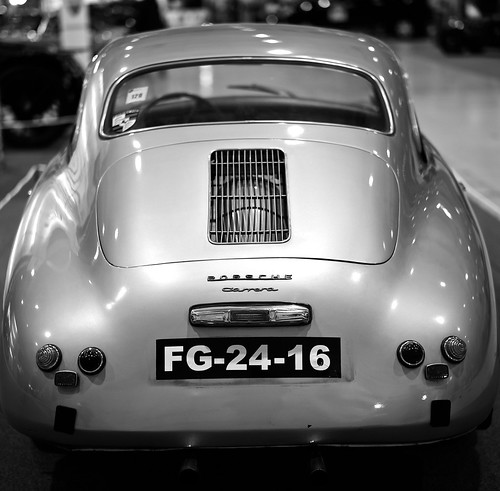
Image by pedrosimoes7
MotorClássicos, Lisbon, Portugal
in Wikipedia
Porsche 356
Porsche 356 Coupe (1964) p1.JPG
Porsche 356 Coupe (1964)
Overview
ManufacturerPorsche
Production1948–1965
DesignerErwin Komenda
Body and chassis
ClassSports car
Body style2-door coupe
2-door convertible
LayoutRR layout
Powertrain
Engine1.1 L B4, 40 PS
1.3 L B4, 44-60 PS
1.5 L B4, 55-70 PS
1.5 L DOHC-B4, 100-110 PS
1.6 L B4, 60-95 PS
1.6 L DOHC-B4, 105-115 PS
2.0 L DOHC-B4, 130 PS
Dimensions
Wheelbase82.7 in (2,100 mm)
Length152.4–157.9 in (3,870–4,010 mm)
Width65.4 in (1,660 mm)
Height48.0–51.8 in (1,220–1,320 mm)
Curb weight1,700–2,296 lb (771–1,041 kg)
Chronology
SuccessorPorsche 911/912
The Porsche 356 is an automobile which was produced by German company Porsche from 1948 to 1965. It was the company’s first production automobile. Earlier cars designed by the company included the Volkswagen Beetle as well as Auto-Union and Cisitalia Grand Prix race cars.
The 356 was a lightweight and nimble-handling rear-engine rear-wheel-drive 2-door sports car available in hardtop coupe and open configurations. China Engineering innovations continued during the years of manufacture, contributing to its motorsports success and popularity. Production started in 1948 at Gmünd, Austria, where approximately 50 cars were built. In 1950 the factory relocated to Zuffenhausen, Germany, and general production of the 356 continued until April 1965, well after the replacement model 911 made its autumn 1963 debut. Of the 76,000 originally produced, approximately half survive.
Porsche No. 1 Type 356 (mid-engine prototype)
Prior to World War II Porsche designed and built three Type 64 cars for a 1939 Berlin to Rome race that was cancelled. In 1948 the mid-engine, tubular chassis 356 prototype called "No. 1" was completed. This led to some debate as to the "first" Porsche automobile, but the 356 is considered by Porsche to be its first production model.[1][2]
The 356 was created by Ferdinand "Ferry" Porsche (son of Dr. Ing. Ferdinand Porsche, founder of the company). Like its cousin, the Volkswagen Beetle (which Ferdinand Porsche Senior had designed), the 356 was a four-cylinder, air-cooled, rear-engine, rear-wheel-drive car utilizing unitized pan and body construction. The chassis was a completely new design as was the 356′s body which was designed by Porsche employee Erwin Komenda, while certain mechanical components including the engine case and some suspension components were based on and initially sourced from Volkswagen. Ferry Porsche described the thinking behind the development of the 356 in an interview with the editor of Panorama, the PCA magazine, in September 1972. "….I had always driven very speedy cars. I had an Alfa Romeo, also a BMW and others. ….By the end of the war I had a Volkswagen Cabriolet with a supercharged engine and that was the basic idea. I saw that if you had enough power in a small car it is nicer to drive than if you have a big car which is also overpowered. And it is more fun. On this basic idea we started the first Porsche prototype. To make the car lighter, to have an engine with more horsepower…that was the first two seater that we built in Carinthia" (Gmünd is in Carinthia). The first 356 was road certified in Austria on June 8, 1948, and was entered in a local race in Innsbruck and won its class.[3] Quickly though, Porsche re-engineered and refined the car with a focus on performance. It is interesting to note that they had introduced the 4-cam racing "Carrera" engine (a design totally unique to Porsche sports cars) before they introduced their own, non-VW pushrod engine case in late 1954. Fewer and fewer parts were shared between Volkswagen and Porsche as the ’50′s progressed. The early 356 automobile bodies produced at Gmünd were handcrafted in aluminum, but when production moved to Zuffenhausen, Germany in 1950, models produced there were steel-bodied. Looking back, the aluminum bodied cars from that very small company are what we now would refer to as prototypes. Porsche contracted with Reutter to build these steel bodies and eventually bought the Reutter company in 1963.[4] The Reutter company retained the seat manufacturing part of the business and changed its name to Recaro.
Little noticed at its inception, mostly by a small number of auto racing enthusiasts, the first 356s sold primarily in Austria and Germany. It took Porsche two years, starting with the first prototype in 1948, to manufacture the first 50 automobiles. By the early 1950s the 356 had gained some renown among enthusiasts on both sides of the Atlantic for its aerodynamics, handling, and excellent build quality. The class win at Le Mans in 1951 was clearly a factor.[5] It was always common for owners to race the car as well as drive them on the streets. Increasing success with its racing and road cars brought Porsche orders for over 10,000 units in 1964, and by the time 356 production ended in 1965 approximately 76,000 had been produced.
Body Styles
Porsche 356 production[6]
TypeQuantity
356 (1948–55)7,627
356A (1955–59)21,045
356B (1959–63)30,963
356C (1963–65/66)16,678
Total76,313
The basic design of the 356 remained the same throughout its lifespan, with evolutionary, functional improvements rather than annual superficial styling changes. Nevertheless a variety of models in both coupe and convertible forms were produced from 1948 through 1965.
Cabriolet models (convertibles with a full windshield and padded top) were offered from the start, and in the early 1950s sometimes comprised over 50% of total production. One of the most desirable collector models is the 356 "Speedster", introduced in late 1954 after Max Hoffman, the sole US importer of Porsches, advised the company that a lower-cost, somewhat spartan open-top version could sell well in the American market. With its low, raked windscreen (which could be removed for weekend racing), bucket seats and minimal folding top, the Speedster was an instant hit, especially in Southern California. Production of the Speedster peaked at 1,171 cars in 1957 and then started to decline. It was replaced in late 1958 by the "Convertible D" model.[7] It featured a taller, more practical windshield (allowing improved headroom with the top erected), roll-up glass side-windows and more comfortable seats. The following year the 356B "Roadster" convertible replaced the D model but the sports car market’s love affair with top-down motoring was fading; soft-top 356 model sales declined significantly in the early 1960s. Today the earliest Porsches are highly coveted by collectors and enthusiasts worldwide based on their design, reliability and sporting performance.
To distinguish among the major revisions of the model, 356′s are generally classified into a few major groups. 356 coupes and "cabriolets" (soft-top) built through 1955 are readily identifiable by their split (1948 to 1952) or bent (centre-creased, 1953 to 1955) windscreens. In late 1955, with numerous small but significant changes, the 356A was introduced. Its internal factory designation, "Type 1", gave rise to its nickname "T1" among enthusiasts. In early 1957 a second revision of the 356A was produced, known as Type 2 (or T2). In late 1959 more significant styling and technical refinements gave rise to the 356B (a T5 body type).
Porsche 356 1600 Super coupé
The mid-1962 356B model was changed to the T6 body type (twin engine lid grilles, an external fuel filler in the right front wing/fender and a larger rear window in the coupe). It is interesting to note that the Porsche factory didn’t call attention to these quite visible changes with a different model designation. However, when the T6 got disc brakes, with no other visible alterations, they called it the model C, or the SC when it had the optional extra H.P. engine.
A unique "Karmann Hardtop" or "Notchback" 356B model was produced in 1961 and 1962. The 1961 production run was essentially a cabriolet body with the optional steel cabriolet hardtop welded in place. The 1962 line (T6 production) was a very different design in that the new T6 notchback coupé body did not start life as a cabriolet, but with its own production design—In essence, part cabriolet rear end design, part T6 coupe windshield frame, unique hard top. Both years of these unique cars have taken the name "Karmann Notchback".[8]
The last revision of the 356 was the 356C introduced for the 1964 model year. It featured disc brakes all round, as well as an option for the most powerful pushrod engine Porsche had ever produced, the 95 hp (71 kW) "SC". 356 production peaked at 14,151 cars in 1964, the year that its successor, the new 911, was introduced to the US market (it was introduced slightly earlier in Europe). The company continued to sell the 356C in North America through 1965 as demand for the model remained quite strong in the early days of the heavier and more "civilized" 911. The last ten 356′s (cabriolets) were assembled for the Dutch police force in March 1966 as 1965 models.
The 356′s four-cylinder pushrod engine was later re-introduced in Porsche’s "entry-level" 912 model, offered between 1965 and 1969 as response to customer complaints that the new 911 (at nearly twice the price of the 356) was too expensive. Although in some ways the 912 did reprise the 356′s specifications, it would not be accurate to say the 912 was successor to the 356; when the decision was made to replace the 356, the 911 was the only car intended to carry the Porsche name forward. Rather the 912 was an afterthought intended to supply the lower-priced end of the market, which the expensive, complex but faster and heavier 911 could not do.
Body design
The car was built of a monocoque (unibody) construction, making restoration difficult for cars that were kept in rust-prone climates.
Engine
Porsche designers made the decision to utilize the engine case they had originally designed for the Volkswagen Beetle. It was an air-cooled pushrod OHV flat-four engine. For use in the 356, they designed new cylinder heads, camshaft, crankshaft, intake and exhaust manifolds and used dual carburetors to more than double the VW’s horsepower. While the first prototype 356 had a mid-engine layout, all later 356′s had a rear-mounted layout. When the four-cam "Carrera" engine became available in late 1955, this engine became an extra cost option starting with the 356A, and was available through the 356 model run.
Legacy
The 356 has always been popular with the motor press. In 2004, Sports Car International ranked the 356C tenth on their list of Top Sports Cars of the 1960s. Today, the Porsche 356 is a highly regarded collector car. The Porsche 356 Carrera (with its special DOHC racing engine), SC, Super 90 and Speedster models are today among the most desirable 356 models. Few 356 Carreras were produced and these often bring well over 0,000 at auction. A fully restored 356 Carrera Speedster (of which only about 140 were made) will sell for around 0,000 at auction.
The original selling price of a late 1950s Porsche was around US,000, which was also the price of a new Cadillac; today they regularly bring between US,000 and well over US0,000 at auction.
Thousands of owners worldwide maintain the 356 tradition, preserving their cars and driving them regularly. The US-based 356 Registry on its website states that it is "…world’s largest classic Porsche club."
356 in racing
The Porsche 356, close to stock or highly modified, has enjoyed much success in rallying, the 24 hours of Le Mans, the 1000 km Buenos Aires, the Mille Miglia, the Targa Florio, the Carrera Panamericana, as well as many other important car racing events.
Several Porsche 356s were stripped down in weight, and were modified in order to have better performance and handling for these races. A few notable examples include the Porsche 356 SL, and the Porsche 356A Carrera GT.
In the early 1960s Porsche collaborated with Abarth and built the Porsche 356B Carrera GTL Abarth coupé, which enjoyed some success in motor sports.